
Even though May 4th has passed, the spirit behind “May the Fourth be with you” is still very much alive. In fact, today is where it really begins, when inspiration turns into action.
At the PAST Foundation, we are constantly looking for ways to reimagine what education looks like. How do we move away from the dry, static formulas of a textbook and toward a living, breathing learning environment? As it turns out, the week of May 4th gives us the perfect cultural hook to do just that.
When we say, "May the Force be with you," we aren’t just quoting a movie. We are tapping into a universal language of curiosity, adventure, and, believe it or not, physics. But the real "Force" we’re talking about today isn't just about push and pull; it’s about student agency.
The Pop-Culture Hook: Why Star Wars Matters
What if we stopped treating "pop culture" as a distraction and started treating it as a bridge?
For many students, the word "physics" sounds like a heavy door closing. It sounds like math problems and friction coefficients. But "The Force"? That sounds like potential. By using a theme like Star Wars to introduce Force and Motion, we meet students where they are. We use a narrative they already love to anchor complex scientific concepts.
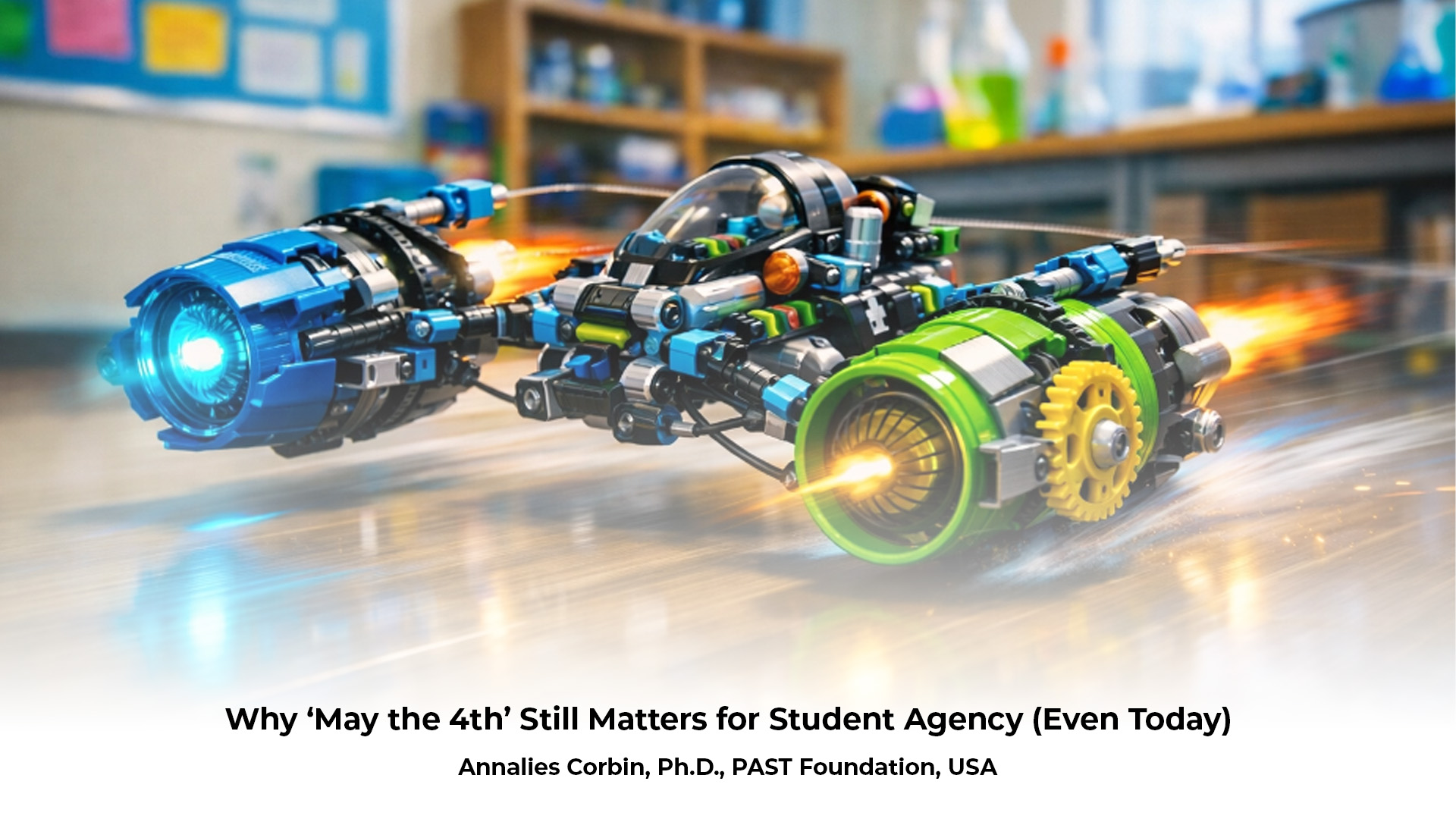
When a student is trying to figure out how to build a podracer that actually glides across the floor, they aren't just "doing a lab." They are problem-solving in a narrative world. This is the heart of engagement. As our CEO Annalies Corbin often says, when kids are deeply engaged in a story, the learning happens almost by accident.
Newton's Laws as Jedi Training
To truly understand force and motion, students need to wrap their heads around Newton’s Three Laws. But instead of memorizing definitions, imagine framing them as the rules of the Star Wars universe:
- Inertia (The "Resting Stormtrooper"): An object at rest stays at rest unless acted upon by an outside force. Why did that droid stop moving? What force is needed to get it going again?
- F = ma (The "X-Wing Equation"): Force equals mass times acceleration. This is where the real fun begins. If you want to move a massive Star Destroyer, how much "force" do you need compared to a tiny TIE fighter?
- Action/Reaction (The "Lightsaber Clash"): For every action, there is an equal and opposite reaction. This is the fundamental principle behind rocket propulsion and every good cinematic duel.
When we frame physics through this lens, we aren't just teaching facts; we are teaching students how to activate their environment. We are showing them that the world operates by rules they can understand, manipulate, and master.
The Secret Ingredient: Student Agency
So, why do we call Force and Motion the "secret" to student agency?
Agency is the power to act. In an educational context, it’s when a student moves from being a passive recipient of information to an active driver of their own learning.
Force and motion units are inherently "messy." They require things to roll, crash, fly, and drop. To teach these concepts well, you have to let go of the "Sage on the Stage" persona and become a mentor: much like a Jedi Master guiding a Padawan.
When a student is tasked with designing a "Force-powered" vehicle (using magnets, air pressure, or gravity), they are faced with a series of choices:
- What materials will I use?
- How will I overcome friction?
- What happens if I increase the mass?
Every one of those questions is an opportunity for agency. They aren't looking for the "right" answer in the back of a book; they are testing their own hypotheses in the real world. This builds grit and resilience. When the podracer doesn't move, the student doesn't "fail": they iterate.
Moving Beyond the Worksheet: Projects that Ignite the Force
To truly transform your classroom for May the 4th (and beyond), you have to move beyond the worksheet. Here are a few ways we’ve seen Force and Motion come to life through student-led projects:
- Magnetic "Force" Mazes: Using magnets to move "droids" through a complex 3D maze. This allows students to explore non-contact forces. It forces them to think about distance, magnetic strength, and the invisible "fields" that govern motion.
- Stop-Motion Cinematic Physics: As highlighted in recent STEM research, creating stop-motion animations with LEGO or figurines is a brilliant way to understand motion. Students have to break down a single movement into tiny, incremental "frames." They begin to see the physics of a jump or a fall in high definition.
- The Great Podrace: Frication and Surface Area: Give students a variety of materials: felt, sandpaper, plastic, wood, and have them design a vehicle that must travel exactly three meters. They have to calculate the force needed to overcome the specific friction of their chosen track.
The Roles of the Educator as a Mentor
Transitioning to an agency-based model can be intimidating. It requires a shift in mindset. Our team, including experts like Marcy Raymond and Kelleigh Huey, works tirelessly to help teachers navigate this transition.
What does it look like to empower students? It looks like asking more questions than you answer.
- "What do you think will happen if we double the weight?"
- "Why did your vehicle veer to the left?"
- "How could we use 'The Force' (physics) to make this more efficient?"
When we empower students to lead their own inquiries, we aren't just teaching science. We are preparing them for a collaborative ecosystem where problem-solving is the most valuable currency. We are helping them build the confidence to look at a challenge and say, "I can figure this out."
Connecting to the Future of Work
The skills learned in a Star Wars-themed physics lab are the same skills needed in the modern workforce. Whether it’s aerospace engineering, robotics, or sustainable transport, the fundamental understanding of how objects move through space is critical.
But more importantly, the human-centric values of agency, curiosity, and iterative thinking are what will allow the next generation to thrive. In an era of AI and rapid automation, the ability to think critically and take initiative is what sets a learner apart.
At PAST, our mission is to link learning to life. By using a cultural moment like "May the 4th", we aren't just having a fun day; we are building a foundation for a lifetime of inquiry. We are showing students that they have the "Force" within them to change their world.
Key Takeaways for Your Classroom
If you're ready to bring the Force to your students this May, keep these principles in mind:
- Embrace the Narrative: Use the story of Star Wars to make the abstract concrete.
- Prioritize Hands-On Exploration: If it doesn't move, it's not a motion lab. Let them build, break, and rebuild.
- Foster Choice: Give students agency over their materials, their designs, and their presentation methods.
- Celebrate the "Fail": In physics, a failed experiment is just more data. Encourage that mindset.
Join the Journey
Are you ready to reimagine your science curriculum? Whether you are an educator looking for new strategies or a parent wanting to support your child’s curiosity, the "Force" of student agency is within reach.
What if we stopped asking "What do you want to be when you grow up?" and started asking "What problems do you want to solve?" When we give students the tools of physics and the freedom of agency, the possibilities are as vast as the galaxy itself.
May the Force (and the physics) be with you!
Want to learn more about how to bring innovation into your classroom? Explore our team page to see the faces behind the movement.
Author: Annalies Corbin, Ph.D., PAST Foundation, USA



Responses