
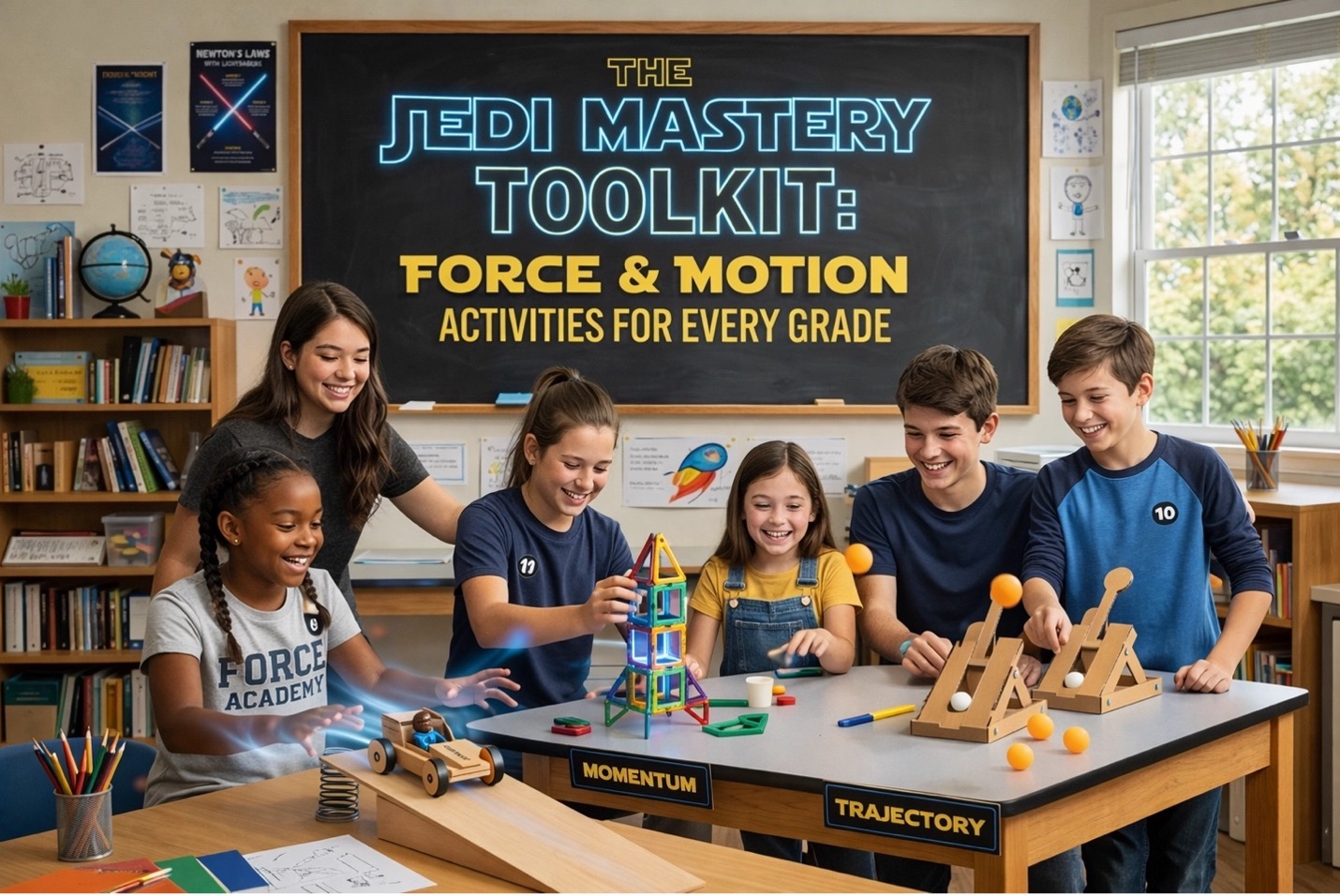
May the 4th be with you! At the PAST Foundation, we say: May the physics be with you.
Each May 4th, educators have a unique opportunity to connect pop culture with meaningful STEM learning. Whether you’re new or experienced, Star Wars offers a magical way to explain science.
Star Wars centers on "The Force"—an energy field that binds the galaxy. In our classrooms, our "force" is the laws of motion. From lightsaber duels to podracers, this galaxy is ideal for testing Newton’s Laws.
But we aren't just teaching formulas; we are "Hacking School." We are reimagining how students engage with science through the five themes of the Hacking School model: Student Agency, Cultural Relevancy, Mastery Learning, Transdisciplinary Learning, and Problem-Based Learning.
Grab your cloak and your data sheets. Here’s what to expect: the activities that follow are organized by grade bands—Elementary, Middle, and High School—so you can easily find ideas that fit your classroom. Within each grade band, you’ll find activities aligned with the Hacking School themes: Student Agency, Cultural Relevancy, Mastery Learning, Transdisciplinary Learning, and Problem-Based Learning. We’re diving into a toolkit of activities designed to turn your students into the next generation of engineers, physicists, and maybe even a few Rebel heroes.
Elementary School: The Youngling Trails
For our youngest learners, the "Force" is often synonymous with "magic." Our job is to help them see the science behind the magic. At this level, we focus on the basic concepts of pushes and pulls, and on how friction affects movement.
- Student Agency: The Great Droid Escape: Give your students the literal steering wheel. In this activity, students build a balloon-powered "droid" (think R2-D2 or BB-8) from recycled materials such as plastic bottles, straws, and bottle caps.
- The Challenge: They must decide how to attach their balloon "engine" to move their droid across a 10-foot "Starship corridor."
- Agency in Action: Let them choose their materials and design. If it doesn't move the first time, don't step in. Ask them, "What force is missing?" or "Is there too much friction?" This empowers them to troubleshoot their own designs.
- Cultural Relevancy: The "Force" Push & Pull: Connect the curriculum to the stories they already love. Use clips of characters using the Force to move objects. Ask the students: "If Yoda moves an X-wing, is it a push or a pull?"
- Activity: Use differently sized "Grogu" (Baby Yoda) figurines or other small toys, blocks, or classroom objects you have on hand. Have students predict how much "Force" (a push from a spring-loaded launcher or a simple flick) is needed to move these objects across different surfaces, such as carpet, tile, cardboard, or wax paper to simulate ice. Feel free to use whatever items and surface materials are available—what matters is exploring how force and friction interact.
- Mastery Learning: Iterative Droid Races
- Physics isn't a one-and-done subject. We want students to embrace the "try, fail, learn" cycle.
- The Hack: After the first droid race, give them a "Repair Bay" day. Use data from the first race to change one variable: maybe a bigger balloon or smoother wheels. This shows them that science is a process of refinement, not just a single grade on a worksheet.
- Transdisciplinary Learning: Literacy & Mechanics
- Don't keep science in a silo. Pair your motion experiments with a creative-writing prompt.
- The Activity: Ask students to write a "Captain’s Log" that explains the physics behind their droid's journey. What obstacles (friction) did they encounter? How did they use a "Force" to overcome them? This seamlessly integrates ELA and NGSS standards.
- Problem-Based Learning: The Galactic Exhibition
- Invite another class, or better yet, parents, to witness a "Droid Rally." Students must explain to their "community" how their droid works, using the terms force, motion, and friction. This reinforces their learning by making them the teachers.
Middle School: The Padawan Path
In middle school, things get a bit more technical. We move from "pushes and pulls" to Newton’s Three Laws of Motion. This is where we start discussing mass, acceleration, and the conservation of energy.
- Student Agency: Podracer Engineering
- Remember the high-speed pod race in The Phantom Menace? It’s a masterclass in Newton’s Second Law (F = ma).
- The Activity: Students build a podracer using a frictionless track (or a string line) and a CO2 cartridge or an air pump. Always follow safety guidelines; CO2 cartridges and pressurized air require supervision and safety goggles. If resources or safety protocols are an issue, use balloon-powered or rubber-band propulsion for similar learning with lower risk.
- Agency in Action: They must balance their podracer's mass with the force of their engine. Do they choose a heavy, sturdy racer or a light, fragile one? The choice and the consequences are theirs.
- Cultural Relevancy: The Physics of "Hover"
- Star Wars is famous for its hover landspeeders. In the real world, we have maglev trains and hovercrafts.
- The Hack: Students research magnetic levitation and compare it to Star Wars' "Repulsorlift" technology. They attempt to build a small-scale hover vehicle using neodymium magnets and craft sticks, then record their findings on how well it hovers.
- Mastery Learning: Data-Driven Calibration
- Students conduct five podracer trials, meticulously recording each trial's time and distance. They analyze the data to identify inconsistencies and performance factors, then prepare a simple speed-time graph for discussion.
- The Hack: They must create a speed-time graph. If their podracer is inconsistent, they must diagnose why. Is the force leaking? Is the mass shifting? Mastery comes from understanding the why behind the numbers.
- Transdisciplinary Learning: The Cost of the Rebellion.
- Introduce economics and math. Give each student a budget of "Galactic Credits." Different materials (balsa wood vs. 3D-printed plastic) have different costs.
- The Hack: Working within a set number of "Galactic Credits," students select materials for their podracer, build and race it, then assess performance and adjust their budget to improve results while staying within the limits.
- Problem-Based Learning: Mentoring the Younglings
- Have your middle school "Padawans" visit an elementary "Youngling" classroom to help students with their droid builds. Nothing solidifies a concept like explaining it to a younger student. It builds leadership and a sense of shared purpose within the school ecosystem.
High School: The Jedi Knight Trails
For high schoolers, we want to push the boundaries of their understanding. We examine rotational dynamics, torque, and the complex kinematics of a lightsaber duel.
- Student Agency: The Biomechanics of the Saber
- Lightsabers aren't just cool; they are essentially glowing blades.
- The Activity: Students use PVC pipes of various lengths and weights to construct model lightsabers. They measure and calculate the torque required to swing each, recording the force needed for a set angular acceleration at the hilt.
- Agency in Action: Students design their own "Saber Style." Do they prefer a long hilt for greater leverage or a short one for speed? They use physics to justify their "combat" choices.
- Cultural Relevance: Energy and Plasma Physics
- A lightsaber is described as "contained plasma." This description is a perfect tie-in to modern fusion research and energy production.
- The Hack: Students research how Tokamak reactors use magnetic force to contain plasma. They relate these findings to the concept of lightsabers as contained plasma, comparing real and fictional containment methods.
- Mastery Learning: Kinematic Modeling
- Students record themselves performing a selected saber move. Using either video analysis software or manual reference points, they map the move’s trajectory, measure distances and times, calculate velocity, and note centripetal force, regardless of the resources available.
- The Hack: This isn't just a lab; it's a model. They iterate on their movement to achieve maximum efficiency, proving that mastery is about precision and data.
- Transdisciplinary Learning: The History of the Blade
- Connect physics to history and physical education. Compare the rotational physics of a Japanese Katana (which influenced Star Wars) with that of a European Broadsword.
- The Activity: How does the center of mass howaffect way these weapons move? Students can work with the PE department to understand the biomechanics of the human body as it applies force.
- Problem-Based Learning: The Jedi Academy Workshop
- Our high schoolers are the leaders of tomorrow. We encourage them to partner with local nonprofits or community centers to host a "Science of Star Wars" night for the public. Students should plan activities for each station, offer hands-on podracer demonstrations, and provide clear explanations of the Force's physics to attendees from the community.
Why This Matters
Education should be about more than memorizing facts; it’s about learning to think and solve real-world problems. By using a theme like Star Wars, we aren't just making science "fun": we are making it accessible.
When a student understands how to manipulate force and motion to make a podracer go faster, they are learning the same principles that researchers use when they examine complex systems and educational ecosystems. We are teaching them that they have the agency to change the world around them.
The "Force" is simply a metaphor for the potential within every student. Our job as educators is to equip them with the tools to harness that potential. Whether they end up at NASA, in a lab, or running their own nonprofit, the skills they gain from a balloon rocket or a PVC lightsaber will stay with them forever.
So, on May 4th, don’t just watch the movies. Get out there and hack your classroom. Use the Jedi Mastery Toolkit to inspire your students to see the world (and the galaxy) a little differently.
May the Force (and the physics) be with you!
Want to learn how to bring these "Hacking School" themes to your district? Check out our Meet the Team page to meet the experts behind the movement, or explore our STEM Maker Space for more hands-on inspiration! We also invite you to share your classroom adaptations, lesson ideas, or student outcomes with our community. Your stories and creativity can inspire fellow educators and spark new ideas for bringing the Force (and the physics) to even more classrooms.
Author: Annalies Corbin, Ph.D., PAST Foundation, USA


Responses