
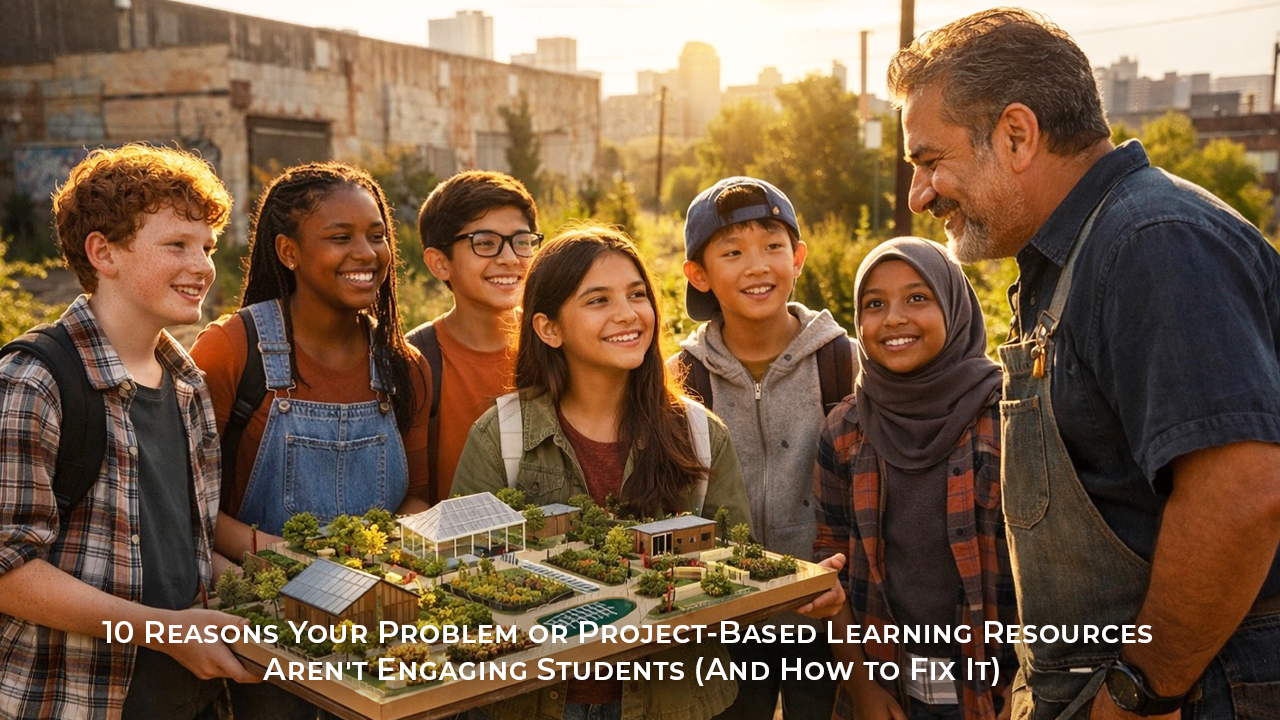
In this journey of discovery, we’re diving deep into the heart of the modern classroom to explore one of the most powerful yet often misunderstood tools in an educator's arsenal: Problem or Project-Based Learning (PBL). We sit down with today's teachers and administrators to address the challenges they face and reimagine what happens when the spark of curiosity meets the structure of innovation.
What if we stopped viewing projects as a break from "real learning" and instead saw them as the catalyst for it? At the PAST Foundation, we believe that when students are truly engaged, they aren't just memorizing facts; they are activating their potential to thrive in a complex world. However, even with the best intentions, PBL resources can sometimes fall flat. If your students are disengaged, it’s rarely a lack of interest: it’s usually a design flaw.
Together, we examine the ten most common pitfalls in PBL design and, more importantly, how we can turn these challenges into opportunities for growth.
- The "Dessert" Problem: Projects as an Afterthought
- One of the biggest reasons students disengage is that the project feels like "extra work" rather than the "main course." When we teach a unit the traditional way and then tack on a project at the end, students see it as a decorative add-on rather than the vehicle for learning.
- The Fix: The Project IS the Curriculum | Shift your perspective. Instead of serving the project as dessert, make it the main course. Start the unit with a "Driving Question" that requires the content knowledge to solve. When students realize they need to learn math or science to complete their mission, engagement skyrockets. This is where we transition from passive consumption to active participation.
- Lack of Authenticity: Solving "Fake" Problems
- Students have a high-functioning "relevance radar." If a project involves solving a problem that doesn’t exist in the real world, they will treat it as a game with no stakes.
- The Fix: Connect to the Community | What does solving a real problem look like? Reach out to local businesses or nonprofits. Ask them: "What is a challenge you’re currently facing?" Whether it’s designing an Embedded Electronics and Smart Design solution for a local manufacturer or creating a marketing plan for a neighborhood garden, real-world stakes build real-world grit.
- Under-Scaffolding: The "Wild West" Effect
- A common misconception is that PBL means letting students do whatever they want. Without proper scaffolding, the "messiness" of a project can turn into chaos. When students feel lost, they disengage.
- The Fix: Build the Ladder | Structure is the friend of creativity, not its enemy. Break the project into phases: Discovery, Ideation, Prototyping, and Presentation. Set benchmarks and schedule "check-ins" to ensure no student is left behind. Use tools such as Advanced Fabrication and Systems Integration frameworks to help them manage complex tasks step by step.
- Ignoring the "Public Product"
- If the only person who ever sees a student’s work is the teacher, motivation is limited to a grade. That’s a transactional relationship, not an inspirational one.
- The Fix: Create a Stage | Every project should culminate in a public product. This could be a community presentation, a published website, or a physical prototype showcased at an event such as a Spring Community Celebration. When students know an audience is coming, they don't just "do the work": they take pride in their craft.
- Standard Misalignment: The "Fluff" Factor
- Sometimes, projects are fun but don't actually teach the required standards. When students (and parents) feel they are just "playing," the perceived value of the work drops.
- The Fix: Map It Out Early | Before you introduce the project, map your learning targets. A visionary educator ensures that every design choice in a project aligns with core skills. By aligning your resources with Advanced CTE and Credentials, you empower students to earn valuable, industry-recognized credentials as they learn.
- Limited Student Agency
- If every student is making the exact same poster or model, it’s not PBL: it’s a recipe. When students have no voice in the process, they have no ownership of the outcome.
- The Fix: Offer Choice within Constraints | Provide a "Menu of Options." While the learning objective remains the same, let students choose how to demonstrate their mastery. One group might build a physical model, while another creates a documentary or a digital simulation. Giving them agency activates their internal drive.
- The Collaboration Gap
- We often put students in groups and expect them to "collaborate" without ever teaching them how to do so. This leads to one student doing all the work while others disengage, creating resentment and a toxic learning environment.
- The Fix: Teach Soft Skills as Hard Skills | Collaboration, resilience, and communication are "core skills" at the heart of the work. Use rubrics that explicitly assess collaboration. Facilitate "soft skill" workshops where students learn to manage conflict and give constructive feedback.
- Resource Inequity
- Engagement drops when students lack the tools they need to succeed. If a project requires expensive materials or high-speed internet that is available only at home, you’ve created a barrier to entry.
- The Fix: School-Based Ecosystems | Ensure that most of the project work happens in the classroom, where you can provide a collaborative ecosystem of tools and support. Whether it's high-tech 3D printers or low-tech cardboard and tape, the focus should be on the thinking process, not the price of the materials.
- Assessment Anxiety: Grades over Growth
- Traditional grading often penalizes the "failure" that is necessary for innovation. If a student is afraid to fail, they won't take the risks required for deep engagement.
- The Fix: Iterative Assessment | Move from "one-and-done" grading to a model of continuous feedback. Allow students to prototype, test, fail, and try again. This builds the resilience and agency required for the future workforce. We explore how shifting the assessment model from "What did you get wrong?" to "What did you learn from this iteration?" can transform the classroom culture.
- The Teacher as the "Sage on the Stage"
- If the teacher remains the only source of truth in the room, it’s not student-centered. Engagement happens when the teacher shifts from being the lecturer to being the lead learner and facilitator.
- The Fix: Become the Lead Learner | Model curiosity. When a student asks a question you don't know the answer to, respond, "I don’t know: how can we find out?" This empowers students to see themselves as researchers and problem-solvers. It shifts the power dynamic and invites them into a partnership of discovery.
Key Takeaways for Your Classroom
- Audit Your Projects: Are they "dessert" or "the main course"?
- Find Your "Why": Connect every project to a real-world problem or community need.
- Balance Freedom with Framework: Scaffolding is the secret sauce of successful PBL.
- Celebrate Publicly: High stakes lead to high engagement.
Transforming the Future, One Project at a Time
At the PAST Foundation, our mission is to empower educators to bridge the classroom and the real world. We know that when we design learner-centered environments, we aren't just teaching a subject: we are building the next generation of thinkers, doers, and innovators.
What does it look like to activate a classroom? It looks like a room where students are so engrossed in their work that they don't hear the bell. It looks like a community that views its schools as hubs of innovation. And it looks like you: the visionary educator, taking the first step toward reimagining what is possible.
Are you ready to activate your classroom? Whether you're looking for a minimalist tote bag to carry your project plans or deep-dive professional development, we are here to support your journey.
Together, let’s build a future where every student has the opportunity to thrive.
Author: Annalies Corbin, Ph.D., PAST Foundation, USA


Responses