Header Logo
Dashboard
Log In
← Back to all posts

The Artemis II Mastery Toolkit: Space-Ready Activities for Every Grade

by Annalies Corbin
Apr 30, 2026
Connect

At the PAST Foundation, we view every significant milestone in human history as an opportunity to rethink education. The Artemis II mission is a prime example. For the first time in more than fifty years, humans are returning to the Moon. This achievement is not only important for NASA but also creates new opportunities for learning in our classrooms.

What happens when we move beyond treating space as just another chapter in a textbook and instead treat it as an active laboratory for learning?

This edition introduces the Artemis II Mastery Toolkit, a set of activities developed through our Hacking School framework. We know that when students have choices, see themselves reflected in their work, and engage with their communities, learning becomes meaningful and lasting. Hacking School removes traditional barriers in education, gives students a voice, encourages creativity, and builds connections to the real world. These activities are designed for educators, administrators, and parents who want to foster curiosity and exploration among their learners.


Elementary School: Building the Foundations of Wonder

For elementary students, Artemis II offers an opportunity to explore both the process and the people behind space exploration. The goal is to help them build the confidence to see themselves as capable participants in these endeavors.

Student Agency: The Mission Specialist Choice

Allow students to choose a mission role that interests them. Instead of assigning the same task to everyone, set up stations where students can engage in different specialist activities.

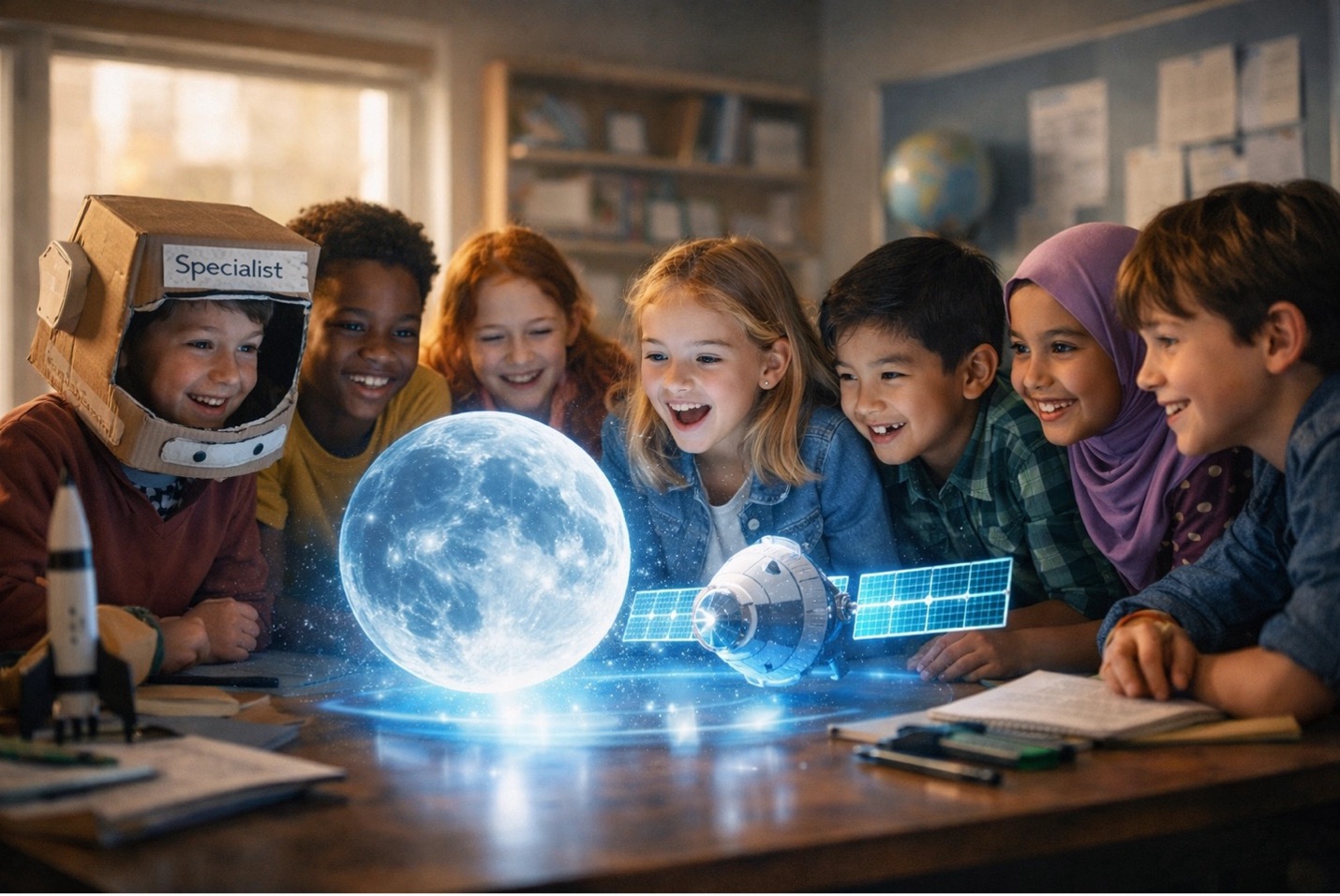
  • The Activity: Students select a mission role: as Flight Surgeon, they design a nutritious "space snack"; as Lead Engineer, they build a model Orion capsule from recycled materials; as Public Affairs Officer, they write a broadcast script as if reporting from the Moon.
  • The Goal: By choosing their path, students take ownership of their learning from day one.

Cultural Relevancy: Faces of the Future

The Artemis II crew represents a range of backgrounds and experiences. Use this as an opportunity for students to see themselves reflected in the field of space exploration.

  • The Activity: "The Next Crew" Portrait Gallery. Have students research the four Artemis II astronauts: Christina Koch, Victor Glover, Reid Wiseman, and Jeremy Hansen. Then have them create a self-portrait as the fifth crew member. What unique skills or cultural background would they bring to the mission?
  • The Goal: To normalize the idea that space is for everyone, regardless of background or gender.

Mastery over Time: The Iterative Rocket Launch

Science is a process of learning through iteration and improvement, rather than achieving perfection on the first try.

  • The Activity: Students use foam pipe insulation or pool noodles to build 'Stomp Rockets.' On day one, they launch the rockets and record distances. On day two, they attach fins to improve stability. On day three, they adjust nose cone weights to observe the effects on flight.
  • The Goal:To help students move beyond simply completing a task to refining and improving their work. This process builds persistence and resilience, both essential for success in STEM fields.

Transdisciplinary Learning: Moon Journals

Space exploration integrates mathematics, art, history, and literacy.

  • The Activity: For one week, students keep a "Lunar Observation Log" (Science/Math), recording daily moon phases and sketches; write a crater-inspired poem (Literacy); and illustrate the lunar landscape (Art).
  • The Goal: To demonstrate that complex challenges benefit from multiple perspectives and disciplines.

Problem-Based Learning & Community Collaboration: The Classroom Mission Control

Designate a section of the classroom as a Mission Control center.

  • The Activity: Invite a local expert—a pilot, meteorologist, or machinery operator—to share how they use communication and checklists. Students then apply these tips to simulate a mission launch in class, using their own checklist and communication plan.
  • The Goal: To connect classroom activities to real-world professional skills and careers.


Middle School: Solving the Engineering Challenges

Middle school students are well positioned to engage with the Engineering Design Process. At this stage, they are ready to move from curiosity to developing practical, real-world solutions.


Student Agency: Designing the Lunar Habitat

Middle school students benefit from opportunities to make independent choices. Encourage them to take ownership of designing their lunar habitats.

  • The Activity: Students design a lunar base that addresses one human need—air, water, or mental health (recreation)—using 3D modeling software (such as Tinkercad) or cardboard prototyping. If technology is limited, they may sketch designs or build models from paper, recycled materials, or clay. This ensures all students can participate, regardless of available resources.
  • The Goal: Empowering students to identify a problem and design a specific solution.

Cultural Relevance: Earth vs. Moon Resources

Relate the Artemis mission to issues and resources on Earth.

  • The Activity: Facilitate a "Resource Scarcity Challenge" by having students compare space station water recycling with local water conservation. Guide a discussion on why a "closed loop" is necessary in space and how these lessons apply locally.
  • The Goal: To make the Artemis mission relevant to global and local sustainability challenges.

Mastery over Time: Programming the Lunar Rover

Learning to code is like learning a new language; proficiency develops over time with practice.

  • The Activity: Students use a microbit (or similar platform) to program a rover to navigate a hallway obstacle course. Allow 3–5 sessions for students to learn basic coding and progress to sensor-based navigation. If robotics equipment isn't available, students can design logic maps or use online simulators to achieve the learning outcomes.
  • The Goal: To develop technical skills by engaging students in increasingly complex challenges.

Transdisciplinary Learning: The Economics of Space

Consider the costs of lunar exploration and evaluate the broader value of these investments.

  • The Activity: A Socratic Seminar. Students research the Artemis mission budget (Math) and read historical documents from the Apollo era (History). They then debate the ethical and economic implications of space exploration versus solving Earth-bound issues.
  • The Goal: To integrate ethical, historical, and economic perspectives into discussions about STEM.

Problem-Based Learning & Community Collaboration: The "Pitch" Competition

Middle school students value opportunities to share their ideas and receive feedback.

  • The Activity: Have students "pitch" their lunar habitat designs to a panel of community members, such as a local architect or a PAST Foundation team member.
  • The Goal: To provide students with experience in professional communication and to receive constructive feedback from individuals outside the classroom.


High School: The Ethics and Complexity of Deep Space

For high school students, the Artemis mission offers opportunities to develop advanced critical thinking and explore potential career paths.

Student Agency: The Artemis Policy Proposal

At the high school level, agency means understanding and influencing systems, whether on Earth or in space.

  • The Activity: Students draft a "Lunar Constitution" that addresses lunar resource management and space law and presents a clear policy proposal on ownership and ethics.
  • The Goal: To help students move from acquiring knowledge to actively shaping policy and decision-making.

Cultural Relevance: Global Cooperation in Space

The Artemis Accords are a collaborative international agreement.

  • The Activity: Assign groups to represent different nations (e.g., USA, Canada, Japan). They must negotiate a shared mission objective that balances their nation's interests with the mission's goal.
  • The Goal: To develop an understanding of the geopolitical factors that shape contemporary scientific endeavors.

Mastery over Time: Long-Term Data Analysis 

High school students are prepared to work with complex datasets related to space exploration.

  • The Activity: Students analyze real-time NASA Artemis data and historical SLS test flight data. Begin by having them interpret basic graphs or calculate averages and percentages from provided datasets. For advanced students, scaffold toward predicting fuel consumption using multi-step equations or estimating orbital trajectories with algebra or calculus. Pair students of different skill levels or set checkpoints for extra support. This approach ensures every learner participates meaningfully, regardless of their current math confidence.
  • The Goal: To apply advanced academic concepts to a project that evolves throughout the semester.

Transdisciplinary Learning: Bio-Regenerative Life Support

This activity integrates concepts from biology and engineering.

  • The Activity: Students design a "Space Garden" by selecting plants, calculating CO2-to-oxygen conversion rates, and building a hydroponic system model that fits within the given capsule size.
  • The Goal: To integrate life sciences and mechanical engineering in a practical context.

Problem-Based Learning & Community Collaboration: Industry Mentorship

Support students as they begin to connect classroom learning to future career opportunities.

  • The Activity: Facilitate a virtual "coffee chat" with a professional to discuss how transdisciplinary skills are applied in the field. Students should prepare a portfolio of their Artemis-themed work to demonstrate the transferability of their skills.
  • The Goal: To bridge the gap between classroom experiences and future careers in the growing space sector.


Activating the Future

The Artemis II mission catalyzes educational innovation. By focusing on student agency, cultural relevance, mastery over time, transdisciplinary learning, and community collaboration, we are preparing students to become the thinkers, problem-solvers, and leaders of the future.

We are interested in learning how you are using Artemis in your classroom. If you are seeking additional resources or support, please visit www.pastfoundation.org or contact us at info@pastfoundation.org. Our team can connect you with materials and guidance tailored to your needs.

Let’s reach for the stars (together).


Author: Annalies Corbin, Ph.D., PAST Foundation, USA


Responses

Join the conversation
t("newsletters.loading")
Loading...
Artemis II: Why Returning to the Moon is a Giant Leap for Your Classroom
Just a few days ago, on April 10, 2026, the world watched the Orion spacecraft bob in the Pacific Ocean after its historic journey around the Moon. As the Artemis II crew, Reid Wiseman, Victor Glover, Christina Koch, and Jeremy Hansen, stepped back onto solid ground, they didn't just bring back data. They brought back a renewed sense of wonder that had been largely absent from our collective c...
Career-Connected Learning: A Better Way to Design Real-World Learning Experiences
  When we talk about workforce development, most people think it happens after students finish school and is a final step before entering the workforce. But what if we started preparing students for real-world work while they are still in the classroom? What if the classroom and the workplace were connected, not separate? At the PAST Foundation, we view career-connected learning as a practical...
The Planning Shift: How Co-Designing Saves Teachers (and Your Weekends)
This article examines an important change in today’s classrooms. If you commented "PLAN" on our recent Instagram post (@annaliescorbin), you’re probably seeking a better way to plan lessons and engage students. Instead of endless prep and stress, this method offers a more sustainable, rewarding approach that helps teachers prevent burnout. At the PAST Foundation, we consider how changes in the ...

Hacking School Newsletter

The best place to learn how to link learning to life
Footer Logo
© 2026 The PAST Foundation

Join Our Free Trial

Get started today before this once in a lifetime opportunity expires.