
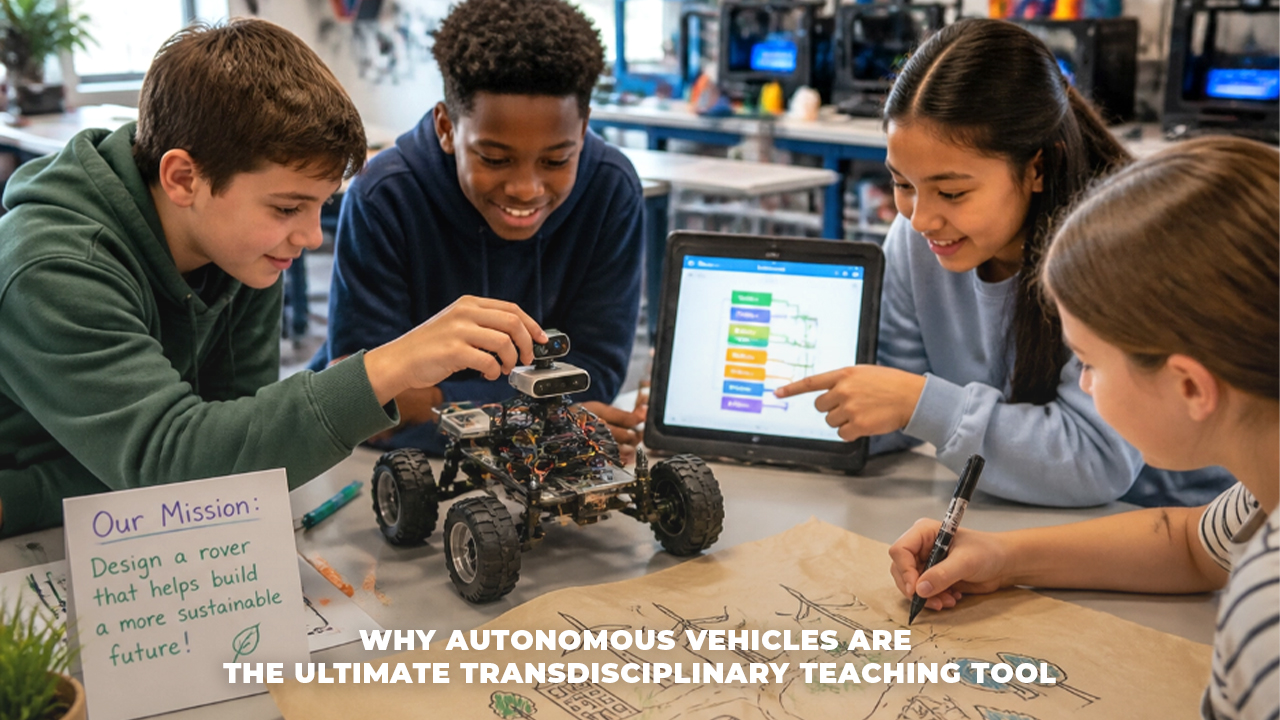
In this first thread of our Future of Mobility series, we’re diving into a topic that often feels confined to a high-tech engineering lab or a Silicon Valley boardroom: Autonomous Vehicles (AV). But at the PAST Foundation, we don’t see AVs as just a "car thing." We see them as one of the most powerful, expansive, and engaging transdisciplinary teaching tools for modern educators.
When we talk about self-driving cars, we aren't just talking about hardware and software. We are talking about the intersection of ethics, urban planning, environmental science, mathematics, sociology, and the very fabric of how our communities function. What if we stopped treating "coding" as an isolated skill and started seeing it as the engine that drives social equity and safer streets?
Welcome to the bridge between today’s classroom and tomorrow’s workforce. Let’s explore why the Future of Mobility is the perfect vehicle (pun intended) to hack school and link learning to life.
Beyond the Hardware: A Transdisciplinary Lens
When most people think of autonomous vehicles, they picture LIDAR sensors, cameras, and complex algorithms. While those are fascinating, the real magic for educators lies in the technology’s transdisciplinary nature. To build a car that drives itself, you don’t just need a mechanic; you need a philosopher, a geographer, a mathematician, and a storyteller.
In a traditional school setting, we often teach these subjects in silos. Math is at 9:00 AM, and Social Studies is at 1:00 PM. But the real world doesn't work that way. Autonomous vehicles demand that we break down those walls.
For example, consider the "Trolley Problem": a classic ethical dilemma that asks how an AI should prioritize lives in an unavoidable accident. This isn't a coding question; it’s a question of philosophy and civics. When students grapple with this, they aren't just learning to program; they are learning to think critically about technology's human impact. This is the heart of Transdisciplinary Teaching, where the problem defines the curriculum, not the other way around.
Driving the Five Kevlar™ Threads
At PAST, everything we do is anchored in our five Kevlar ™ threads: Student Agency, Culturally Relevant Education, Mastery Learning, Transdisciplinary Teaching, and Problem-Based Learning. Autonomous vehicles hit every one of these marks with high-octane precision.
- Problem-Based Learning (PBL): The Real-World Hook
- PBL starts with a messy, complex problem that doesn't have a single "right" answer. AV technology is the ultimate "messy" problem. How do we ensure a car can "see" a pedestrian in a snowstorm? How do we design a city layout that prioritizes people over parking lots? By framing an entire unit around the "Future of Mobility," you give students a tangible reason to master physics, geometry, and persuasive writing. They aren't doing a worksheet; they are solving for the safety of their future neighbors.
- Student Agency: Putting Students in the Driver's Seat
- One of the most transformative shifts in education occurs when we move from "teacher-led" to "learner-centered." When students engage with AV concepts, they become the architects of the future. They aren't just consumers of technology; they are the designers. Whether using Advanced Fabrication to prototype a sensor mount or using Embedded Electronics to wire a miniature model, they make choices that matter. This sense of ownership and agency is what builds the grit and confidence needed for the 21st-century workforce.
- Culturally Relevant Education: Mapping Equity
- This is where the AV conversation gets really interesting. Technology is never neutral. Where do autonomous shuttles go, and who has access to them? In many urban environments, "transit deserts" keep people from reaching healthcare or groceries.
- By examining AV through the lens of Culturally Relevant Education, students can analyze their own neighborhoods. They can ask: "Would an autonomous bus help my grandma get to the doctor?" or "Why are the sensors having trouble recognizing people with darker skin tones?" By bringing these real-world equity issues into the classroom, we make the technology relevant to every student’s lived experience, ensuring that the "Future of Mobility" includes everyone.
- Mastery Learning: The Power of the Pivot
- In the world of autonomous systems, your first piece of code almost never works perfectly. The car might veer left when it should go right, or stop for a shadow. This is the ideal environment for Mastery Learning. Instead of getting a "C" on a test and moving on, students iterate. They test, fail, analyze, and try again. This process of continuous improvement is exactly what we advocate in our program designs. It shifts the focus from "the grade" to "the competency."
- Transdisciplinary Teaching: The Ultimate Synergy
- As mentioned, AV is the glue that holds disciplines together. It enables a physics teacher and a government teacher to co-teach a unit on traffic laws and kinetic energy. It also enables an art teacher to lead a session on user interface (UI) design for passenger screens. When we reimagine education this way, school becomes an exciting, interconnected ecosystem rather than a series of disconnected boxes.
Why Should Educators Care Right Now?
You might be thinking, "Annalies, my school doesn't have a fleet of self-driving Teslas. How am I supposed to teach this?"
Here is the secret: You don’t need the car to teach the concept. The Future of Mobility is a mindset. It’s about teaching students to navigate a world where AI and automation are the norm. It’s about preparing them for careers that don’t even exist yet: jobs in "Autonomous Fleet Management" or "AI Ethics Auditing."
By introducing these concepts now, we are empowering our students to decide how this technology serves humanity. We are moving them from passive users of the future to active creators of it. This is why we created our Portable Innovation Labs: to bring these high-tech concepts into any classroom, regardless of zip code or budget.
The Human-Centric Future
At the end of the day, autonomous vehicles are a human story. They are about our desire to move, connect, and stay safe. When we teach AV, we teach students to care for their community through the lens of innovation. We ask them: What does it look like to thrive in a world that is constantly moving?
We want our students to be thinkers who can look at a self-driving car and see more than a machine. We want them to see the urban planner’s vision, the coder’s logic, the advocate’s call for equity, and the engineer’s precision.
What if we stopped teaching kids to pass tests and started teaching them to design the future?
That’s what the Future of Mobility series is all about. It’s about looking beyond the hardware to see the infinite educational possibilities that emerge when we let students take the wheel (even if that "wheel" is digital).
What's Next?
This is just the setup. Now that we’ve framed why Autonomous Vehicles are the ultimate transdisciplinary tool, it’s time to get practical.
How do you actually do this with a group of 3rd graders? What does an AV ethics debate look like for a high school senior? On Thursday, we’re going to break it all down. I’ll share specific, hands-on activities tailored for Elementary, Middle, and High School levels. We’ll show you how to turn these big, visionary ideas into classroom reality.
Stay tuned, keep dreaming big, and let’s get ready to drive change together!
Author: Annalies Corbin, PAST Foundation, USA



Responses