
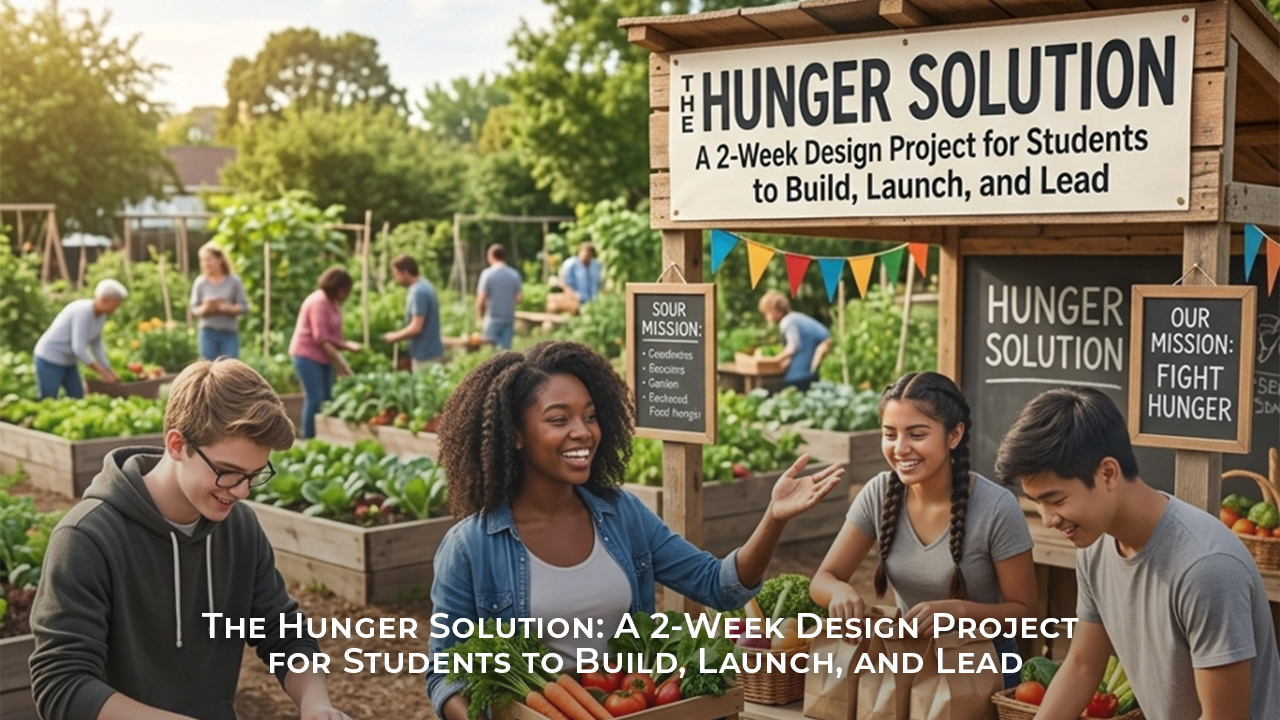
If you saw my post, "Whose Classroom Is This?", you know we’re beyond the "sage on the stage" model. We’re done with rows of desks and the passive absorption of facts that will be forgotten the second the Scantron is turned in. We’re pushing for something bigger: agency. We want students to realize they aren’t just preparing for the "real world": they are already in it.
Today, we’re putting Tuesday’s 10 pitfalls/fixes into practice with 10 clear success factors. We’re tackling a heavy-hitter: Community Hunger.
But we aren’t just running a canned food drive. (Seriously, stop with the canned food drives unless students are also unpacking the systems behind access, waste, distribution, and decision-making.) We’re using Artificial Intelligence (AI) as a lever, not a shortcut. Students can use AI to analyze data, optimize routes, prototype solutions, and ask better questions about what their community actually needs.
Let’s reimagine what happens when we stop teaching about problems and start asking students to solve them.
The Framework: 10 Success Factors for the Hunger Solution
Before we dive into the 14-day calendar, let’s look at the DNA of this project. Whether you’re teaching third graders or high school seniors, these 10 success factors keep the work grounded in purpose, rigor, and student agency.
- The Main Course (Project is the curriculum): This is not the “fun thing after the real learning.” The project is the learning. Students build literacy, math, science, and civic understanding by tackling community hunger.
- Community Connection: Food insecurity is not a “somewhere else” issue. It exists in neighborhoods, schools, food pantries, grocery systems, and family routines. Students investigate what is happening locally and who is already doing the work.
- Building the Ladder (Scaffolding): Students don’t jump from an empathy interview to a polished solution in a day. They move through guided research, structured brainstorming, low-stakes drafts, feedback rounds, and revision.
- Creating a Stage (Public Product): Student work should go somewhere real. Teams create a public-facing product: a pitch, prototype, campaign, map, policy memo, awareness tool, or operational plan for a real audience.
- Map It Out Early (Standards Alignment): This project intentionally aligns with NGSS engineering design, Common Core ELA research and argumentation, and mathematics through data analysis, modeling, and problem solving.
- Offering Choice: Not every team needs to address the same part of the problem. Some students may focus on cafeteria waste, while others focus on transportation, pantry access, nutrition education, or donation systems.
- Teaching Soft Skills (Collaboration): The heart of the work is not just the final prototype. It’s how students listen, divide responsibilities, navigate disagreements, and build shared ownership.
- School-Based Ecosystems (Resource Inequity): Great ideas can’t rely on perfect conditions. The project should adapt to the tools, time, transportation, and technology actually available in a school community.
- Iterative Assessment (Growth over Grades): We assess the process as much as the product. Students reflect, revise, test, and improve. Growth matters more than polish.
- Become the Lead Learner: The teacher is not the compliance manager. The teacher is the lead learner, modeling curiosity, asking strong questions, opening doors for partners, and learning alongside students.
One Goal, Three Paths: Elementary, Middle School, and High School
We don't expect a 4th grader to write code for a predictive AI model, but we do expect them to understand how a machine can help us identify patterns. Here’s how the "Hunger Solution" scales:
Elementary: The Food Waste Detectives
Focus: Empathy and Data Patterns.
Students use AI to categorize cafeteria food waste. They build "Smart Bin" prototypes (using cardboard and micro:bits) that help peers sort food that can be shared (such as unopened milk) from food that must be composted.
- AI Hook: Use AI image recognition tools to identify and count types of waste.
Middle School: The logistics Wizards
Focus: Systems and Distribution.
Students map out "Food Deserts" in their city. They use AI to brainstorm delivery routes or app features that connect local restaurants to shelters. They create a business plan for a "Pop-Up Pantry" that relocates based on community need.
- AI Hook: Use AI to simulate "What-if?" scenarios, e.g., "If we have 50 lbs of surplus bread in Zone A, but the highest need is in Zone B, what is the most fuel-efficient route?"
High School: The System Disruptors
Focus: Policy, Predictive Modeling, and Entrepreneurship.
Students dive into the "why" behind the "what." They use AI to analyze local policy barriers (such as liability laws for food donation) and draft policy memos. They build functional app prototypes or social enterprise models that use predictive AI to forecast when a local pantry will run low, based on historical data.
- AI Hook: Using AI for advanced data visualization and for drafting professional-grade pitches to city officials.
The 2-Week "How-To" Guide
This is a cross-curricular blitz. It requires the math, ELA, and science teachers, and really anyone working with learners, to stop acting like they live on different planets. Together, we build a learner-centered environment where the project is the main course, not the dessert.
Week 1: The "Why" and the "What"
- Day 1: The Hook & The Community Connection: Start with a local map. Where is the food? Where are the people? What if we asked students to trace both surplus and need within the same community? Guest speaker alert: Bring in a local community expert to connect the challenge to real community impact.
- Day 2: Map It Out Early. Students use AI and local data sources to research food insecurity, transportation gaps, food waste, and access patterns. Teachers make the standards visible by having students read informational text, analyze data, ask scientific questions, and identify root causes. This is a great opportunity for students to practice responsible AI use!
- Day 3: Building the Ladder.Teams form, and scaffolds go up. Students narrow their focus with teacher support, sentence stems, research organizers, planning templates, and checkpoints. Are they solving school waste, neighborhood access, restaurant surplus, or pantry awareness?
- Day 4: Offering Choice. This is where the project opens up. Students use AI as a creative partner to generate and sort ideas aligned with the niche they choose. Prompt: "I am a 10th grader trying to solve food transport issues in a rural area. Give me 10 low-cost ideas that use existing community resources."
- Day 5: Teaching Soft Skills. Groups pitch early ideas to “Critical Friends” and practice listening, giving feedback, sharing airtime, and identifying one major flaw in their own plan. Collaboration is not assumed; it is taught intentionally.
Week 2: The "How" and the "Who
- Day 6: School-Based Ecosystems.Teams prototype using the resources they actually have. Cardboard models for younger students, spreadsheets and wireframes/3D prints for older students, and paper mock-ups when devices are limited. Resource inequity should shape the design conversation, not shut it down.
- Day 7: Iterative Assessment. Students test, reflect, and revise. Teachers confer with teams, use quick rubrics, and document growth across grades. AI can help students compare versions, refine messaging, or identify missing stakeholders. Again, a chance to practice responsible use of AI with students.
- Day 8: Become the Lead Learner. Teachers, this is your moment. Ask questions that deepen the work: "What happens if the power goes out?" "How does an elderly resident without a smartphone use this?" "Who is still excluded?" Model curiosity rather than control.
- Day 9: Craeting a Stage. Students prepare a public product, not merely a classroom artifact. They build persuasive presentations, prototypes, policy briefs, awareness campaigns, or operational plans. They use AI to anticipate audience questions and refine their communication.
- Day 10: The Showcase. This is the big one. Invite the community. Students present their ideas to people who can actually act on them, which is exactly why the project matters.
Why This Works (and Why You Should Do It)
This project isn't just about hunger. It’s about building the "muscles" of a modern workforce.
When students use AI to solve a community problem, they aren't just learning to prompt: they are learning algorithmic thinking. When they realize that a local restaurant wants to donate but lacks containers, they are learning systems thinking. When they stand before a city council member to explain their data, they are learning agency.
We often talk about "preparing students for the future," but the future is already here. AI is already here. Hunger is already here.
At the PAST Foundation, we believe the most powerful thing you can do in a classroom is to get out of the way and let students lead. Give them the tools: AI, data, and the 10 success factors. Then watch them transform their world.
So whose classroom is it? If you follow this 2-week guide, the answer won't be "mine." It will be "ours."
Let’s get to work. The world is hungry for what your students can accomplish.
Author: Annalies Corbin, Ph.D., PAST Foundation, USA



Responses