
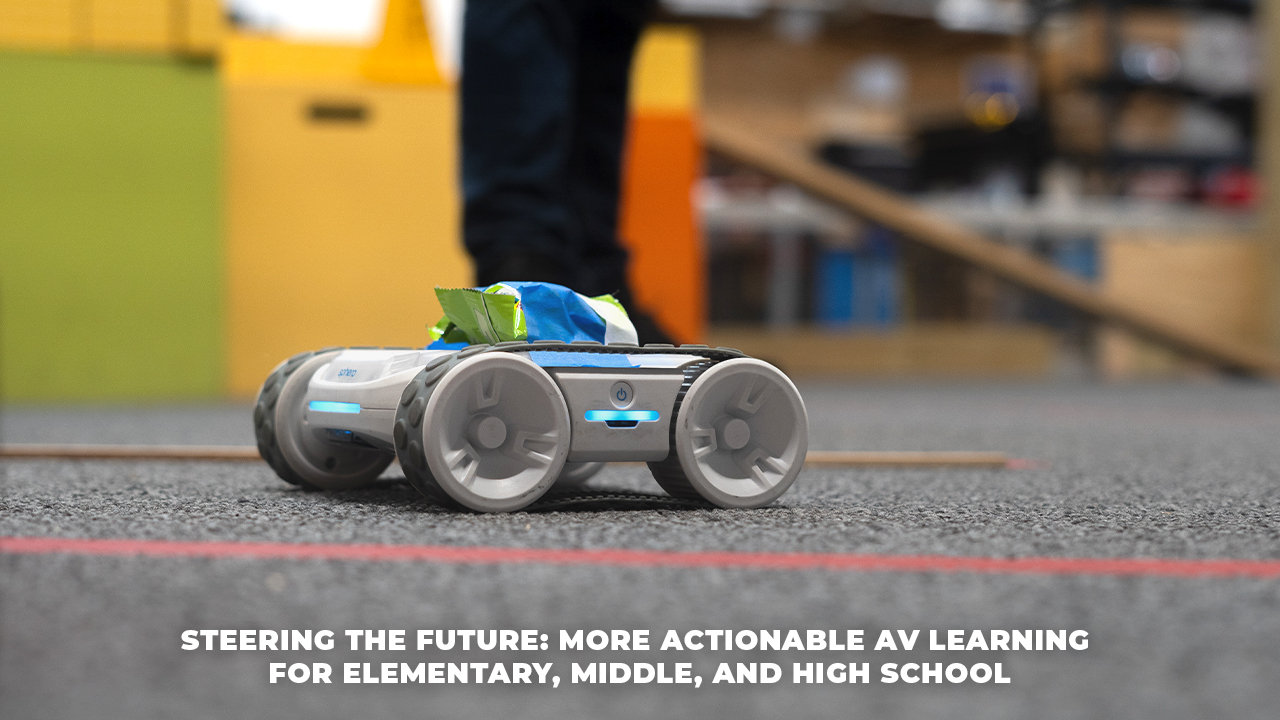
Welcome back to the second half of our series, "The Future of Mobility." Earlier in the series, we made the case that Autonomous Vehicles (AV) are a powerful entry point for transdisciplinary learning because they connect technology, design, ethics, systems thinking, and community relevance in a highly visible real-world challenge. This follow-up turns that big idea into classroom practice by offering more explicit moves teachers can make in elementary, middle, and high school settings while staying aligned with the life-linked approach at the heart of Hacking School: Five Strategies to Link Learning to Life.
The goal is not to add another disconnected activity to an already full week. It is to help teachers use AV as a compelling context for inquiry, student agency, problem-solving, and authentic connection to the world students already live in. In other words, this is less about "teaching autonomous vehicles" and more about using mobility as a lens to help learners ask better questions, test ideas, communicate clearly, and see themselves as capable participants in the future taking shape around them.
Why AV Works as a Hacking School Context
AV technology is a strong teaching context because it naturally crosses the boundaries that schools often keep separate: science, engineering, social studies, literacy, design, and civic decision-making. This makes it a natural fit for the core spirit of Hacking School, which asks educators to move beyond isolated content delivery toward work that is relevant, applied, and connected to life beyond the school walls.
For teachers, that means a shift in planning. Instead of starting with, "What chapter comes next?" start with, "What real problem, system, or decision can students investigate?" AV quickly opens that door by allowing students to explore how machines sense the world, how algorithms make choices, how cities adapt to new technologies, and how careers emerge as new systems are built.
A useful planning frame:
- What is the real-world problem or tension?
- What do students need to understand to engage it well?
- What can they make, test, debate, map, explain, or improve?
Who outside the classroom might care about their thinking?
That sequence keeps the work anchored in the same practical, life-linked mindset educators value in Hacking School while making the lessons more actionable on Monday morning.
Elementary School: Curiosity, Sensing, and Simple Systems
At the elementary level, the work should remain concrete, playful, and highly observable. Students do not need technical jargon first; they need experiences that help them notice that "smart" systems are designed, that machines use inputs to make decisions, and that people create the rules those systems follow.
Essential Question
How does a machine know what to do?
Teacher Moves That Deepen Learning
- Start with familiar objects, not abstract definitions. Place a toy car, a smart speaker, a robotic vacuum, a bicycle, and a pet photo in front of students, then ask which can sense, decide, and act.
- Build vocabulary from student observations. Introduce terms such as sensor, command, signal, path, and obstacle only after students describe what they observed.
- Keep a visible anchor chart of the cycle: sense, plan, act. Revisit it during every activity so students begin to recognize a transferable systems pattern.
Activity 1: "Robot or Not?" Socratic Circle
Invite students to a short discussion about what makes something a robot. The original version of this lesson already directs teachers to compare objects such as a toaster, a remote-controlled car, a delivery bot, and a dog. To deepen the lesson, ask students to defend their thinking with evidence such as "it responds," "it follows instructions," or "it changes what it does when the environment changes".
To make the discussion more actionable for teachers, add three rounds:
- Sort images into "robot," "not a robot," and "not sure yet."
- Ask students what evidence would help them decide.
- Revisit the sort after the class learns the sense-plan-act cycle.
This small revision turns a conversation starter into an evidence-based reasoning routine. It also helps young learners practice revising their views when new information becomes available, a habit that matters across every subject area.
Activity 2: Human Sensors (The Blindfold Navigation)
- The Setup: Pair students up. One is the "AV" (blindfolded), and the other is the "Programmer."
- The Goal: The Programmer must guide the AV through a simple obstacle course using only specific, pre-determined verbal "code" (e.g., "Step forward 2," "Rotate 90 degrees left").
- The Twist: Introduce "Sensors." Give the blindfolded student a pool noodle. If the noodle touches an object, that’s their "proximity sensor" triggering. They have to stop immediately. This demonstrates how a car uses ultrasonic sensors to avoid hitting a curb or a pedestrian.
To deepen this experience, teachers can add:
- A prediction phase: students sketch the route before trying it.
- A debugging phase: after a failed attempt, partners identify exactly which command caused the problem.
- A reflection phase: students complete the sentence, "The car got confused when..."
Those three additions move the lesson from a fun game to an introduction to testing, revision, and cause-and-effect reasoning. They also create an early bridge to computational thinking without requiring screens.
Activity 3: Unglugged Mapping
Using tape on the floor to create a city grid is already a strong idea; the deeper move is to make route design matter to someone beyond simply finishing the maze. Instead of sending the delivery bot anywhere, assign a purpose: deliver medicine to the hospital quickly, bring groceries to a family, or reroute around a blocked street after a storm.
Teachers can then ask students to compare routes using practical criteria:
- Which path is fastest?
- Which path is safest?
- Which path uses the fewest turns?
- What should the robot do if a road is blocked?
Now the activity supports math language, writing, oral explanation, and design trade-offs all at once. That is the kind of interdisciplinary lift that makes a context like AV worth using.
What Implementation Looks Like
For elementary teachers, a strong 45- to 60-minute lesson sequence could include a 10-minute launch with pictures and predictions, a 20-minute partner challenge, a 10-minute redesign or retry, and a closing circle in which students explain one thing the robot needed to succeed. Student products might include a route card, a labeled drawing of a sensor system, or a simple class book titled How Our Robot Knows Where to Go.
Hacking School Connection
This band works best when teachers emphasize wonder, relevance, and voice. Students are not just learning what a sensor is; they are beginning to understand that the systems around them are designed by people and can be examined, improved, and questioned.
Middle School: Ethics, Design, and Community Impact
Middle school is the ideal setting to shift from "How does it work?" to "How should it work?" Middle schoolers are at that perfect age when they start questioning everything, especially the "rules." This is the ideal time to introduce the ethics of AI and the complexity of urban design. We’re moving from "How does it see?" to "How does it decide?" Ethics and urban design are natural entry points, and these topics deepen engagement because adolescents are developmentally ready to challenge rules, argue from evidence, and imagine alternatives.
Essential Question
How do people decide what a smart system should do?
Teacher Moves That Deepen Learning
- Frame the work around competing values, not right answers. Safety, convenience, fairness, efficiency, accessibility, and privacy often pull in different directions.
- Use structured controversy protocols so students must consider more than one viewpoint before settling on an argument.
- Ask students to connect each design decision to a real community impact.
Activity 1: The AI Ethics Debate
In 2026, the "Trolley Problem" is no longer a philosophical trope but a policy discussion.
- The Scenario: An AV's brakes fail. It must choose between hitting a group of pedestrians and swerving into a wall, potentially injuring the passenger.
- The Challenge: Have students work in small groups to "program" the car’s priorities. Should the car protect its owner at all costs, or should it minimize total harm?
- The Connection: This aligns with the Social Justice and Equity inquiry. Who decides the "value" of a life within an algorithm? This is an effective way to use our Hacking School strategies to connect high-level ethics to real-world technology.
The AV brake-failure scenario is useful because it surfaces a hard truth: algorithms reflect human priorities. To deepen the lesson, avoid reducing it to a simple "gotcha" version of the trolley problem. Instead, give groups a design brief: create a decision policy for an AV shuttle serving your town, then explain which values guided that policy and who might benefit or be harmed.
A stronger classroom sequence looks like this:
- Present the scenario and define key terms such as liability, bias, risk, and stakeholder.
- Assign stakeholder roles, such as passenger, pedestrian, parent, disability advocate, city planner, or insurance provider.
- Have teams draft a decision policy and publicly justify it.
- Debrief by asking which voices were easiest to ignore and why.
This reframes the activity as a civic reasoning lesson rather than a one-answer ethics puzzle. It also aligns with the Hacking School emphasis on connecting learning to authentic human questions rather than keeping it safely theoretical.
Activity 2: Designing the AV-First City
How does a city change when cars drive themselves? Give students a map of their local downtown.
- The Task: Redesign a three-block radius. If we don’t need street parking (because AVs drop people off and leave), what do we do with that space? Do we add bike lanes, parks, or outdoor classrooms?
- The Tool: Use a basic simulator or Minecraft Education Edition to build these "Cities of the Future."
Giving students a local downtown map is a strong starting point because it roots the work in place. To deepen the lesson, require students to redesign a three-block area around an actual community goal: safer access to school, reduced congestion, more inclusive transit, or more public gathering space.
Students should work with a design brief that includes:
- A map of the area.
- A list of user groups, such as families, elders, cyclists, wheelchair users, business owners, and bus riders.
- A constraint, such as a budget, limited curb space, or a school arrival bottleneck.
- A final deliverable, such as a sketch, digital build, or short planning presentation.
The critical teacher move here is to require trade-off language. Students should explain not only what they changed but also what they gave up and why. That expectation raises the task from imaginative redesign to systems thinking.
Activity 3: Block Coding Simulators
Using platforms such as VEXcode VR or Amazon Future Engineer’s Cyber Robotics Challenge, have students program a virtual vehicle to navigate a warehouse. They’ll learn about "If-Then" statements: If the sensor detects an obstacle, then turn left. This is the logic of autonomy in a low-stakes, high-engagement environment.
Using platforms such as VEXcode VR or Amazon Future Engineer's Cyber Robotics Challenge is practical because they allow students to test autonomous logic in a low-risk setting. To deepen implementation, teachers should avoid assigning only "finish the maze" tasks and instead structure challenges around conditions and constraints.
For example, ask students to program a virtual vehicle that must:
- Deliver supplies efficiently.
- Stop at marked pedestrian crossings.
- Reroute if an obstacle appears.
- Log where failures happened.
Students then compare code not only for correctness but also for elegance, efficiency, and reliability. This reinforces the idea that engineering is iterative and that "working once" is not the same as robust design.
What Implementation Looks Like
A strong middle school mini-unit could span three class periods: one day for ethics and stakeholder analysis, one for city redesign, and one for coding or simulation. Student products might include a policy memo, a neighborhood redesign board, and a short reflection explaining how their technical choices affected people.
Hacking School Connection
This band is where the life-link becomes especially visible. Students can see that technology is never only technical; it is cultural, political, spatial, and ethical, which is exactly why transdisciplinary learning matters.
High School: Systems, Policy, and Career Pathways
At the high school level, students are ready for greater technical complexity and stronger connections to postsecondary pathways, workforce development, and civic leadership. The original draft already identifies LiDAR, policy, fabrication, and credential-linked experiences as strong anchors, and these anchors become even more powerful when students are asked to produce work that mirrors the work of adults in the field.
Essential Question
How do we build and govern mobility systems people can trust?
Teacher Moves That Deepen Learning
- Treat students as emerging professionals. Assign roles such as technician, policy analyst, design engineer, data specialist, or public-interest reviewer.
- Request authentic deliverables, such as technical explanations, design proposals, risk analyses, or public pitches.
- Connect tasks to visible pathways across advanced manufacturing, computing, engineering, public policy, and community planning.
Activity 1: The LiDAR Deep Dive
High school students can handle the "heavy" tech. Using mobile devices with LiDAR capabilities to let students scan a classroom and analyze a point cloud.
- The Concept: Explain LiDAR (Light Detection and Ranging). It’s how the car "sees" in 3D.
- The Hands-on: Using simple mobile apps that utilize LiDAR (common on many smartphones now), have students scan the classroom. They can analyze the "point cloud" and discuss how an AI interprets these points as "objects."
- The Link: This ties directly into our Embedded Electronics and Smart Design credentials. Understanding the hardware is the first step toward a career in advanced manufacturing.
To deepen that task, ask students to move beyond "cool visualization" and investigate what the data does and does not capture.
Teachers can structure the lesson around these prompts:
- What objects are easy for the sensor to identify?
- What objects create confusing or incomplete data?
- How might rain, glare, darkness, or clutter affect system reliability?
- Why does sensor error matter in safety-critical systems?
That line of inquiry helps students understand that sensing is probabilistic and imperfect, not magical. It also provides a direct pathway to technical careers in calibration, testing, quality assurance, and systems integration.
Activity 2: Policy and Workforce Shark Tank
The technology for AV is mostly here, but the policy is still a mess.
- The Challenge: Students act as a startup proposing an AV shuttle service for their town. They must address:
- Liability: Who is at fault in an accident?
- Equity: How do we ensure people without smartphones can use the service?
- Sustainability: Is the fleet electric? How is it powered?
- The Pitch: Students present to a "City Council" (their peers or actual local officials) for a chance to "win" the contract.
The startup shuttle pitch is an excellent activity because it blends engineering, entrepreneurship, and public decision-making. To deepen the experience, provide students with a formal request for proposals and require them to address liability, accessibility, sustainability, rider experience, data use, and workforce needs in one coherent plan.
A rigorous version of the task asks each team to submit:
- A one-page service overview.
- A route or service area map.
- A budget sketch or operating logic.
- A community access plan for riders without smartphones.
- A risk and responsibility statement.
- A short oral pitch to a review panel.
This structure helps students practice the reality that technological solutions rise or fall not only on innovation but also on implementation, public trust, and equitable access.
Activity 3: Advanced Fabrication for Mobility
Encourage students to design and 3D-print components for a small-scale autonomous bot. This is an effective way to connect AV concepts to advanced manufacturing, fabrication, and systems integration pathways. To deepen the lesson, shift the task from "make a part" to "solve a design problem."
Possible design briefs include:
- Build a sensor mount that improves the field of view.
- Design a bumper that protects components during low-speed collisions.
- Create a chassis modification for carrying medical supplies.
- Prototype a weather shield that protects electronics without blocking sensors.
Students should test, document, and revise their designs. A brief engineering log that records constraints, failures, and improvements can make the learning far more transferable than a one-off print job.
What Implementation Looks Like
A strong high school sequence could be structured as a one- to two-week challenge anchored by a public showcase. Student products might include a scan analysis, a fabrication prototype, a policy pitch deck, or a career reflection that connects project work to local industries and future training opportunities.
Hacking School Connection
This is where students can most clearly see themselves in the story. They are not passive recipients of future technology; they are potential builders, auditors, maintainers, critics, and leaders in it.
Cross-Band Design Principles Teachers Can Use Immediately
Across grade bands, a few implementation choices make these lessons stronger and more faithful to the spirit of Hacking School.
- Start with a meaningful problem, not a vocabulary list.
- Make student thinking visible through talk, sketching, mapping, building, or coding.
- Built in revision, so students experience iteration rather than one-shot completion.
- Use authentic audiences whenever possible, including peers, families, local planners, business partners, or community leaders.
- Ask students to consider who benefits, who is burdened, and whose voice is missing.
These moves help teachers sustain the energy of innovation while keeping the work grounded in relevance, reflection, and real-world transfer.
Why This Matters Right Now
The future of mobility is no longer hypothetical, but schools still have work to do if students are to engage with that future as informed participants rather than passive consumers. That insight remains central.
By bringing AV learning into classrooms in developmentally appropriate ways, teachers are doing much more than introducing transportation technology. They are helping students practice critical thinking, technical literacy, ethical reasoning, civic imagination, collaboration, and connecting classroom learning to the systems that shape everyday life.
That is the deeper promise here, and it is exactly why this topic belongs in a Hacking School conversation. When teachers design learning that connects curiosity to context and ideas to action, students begin to recognize that school is not preparation for life later; it is a place to engage with life now.
Author: Annalies Corbin, PAST Foundation, USA



Responses