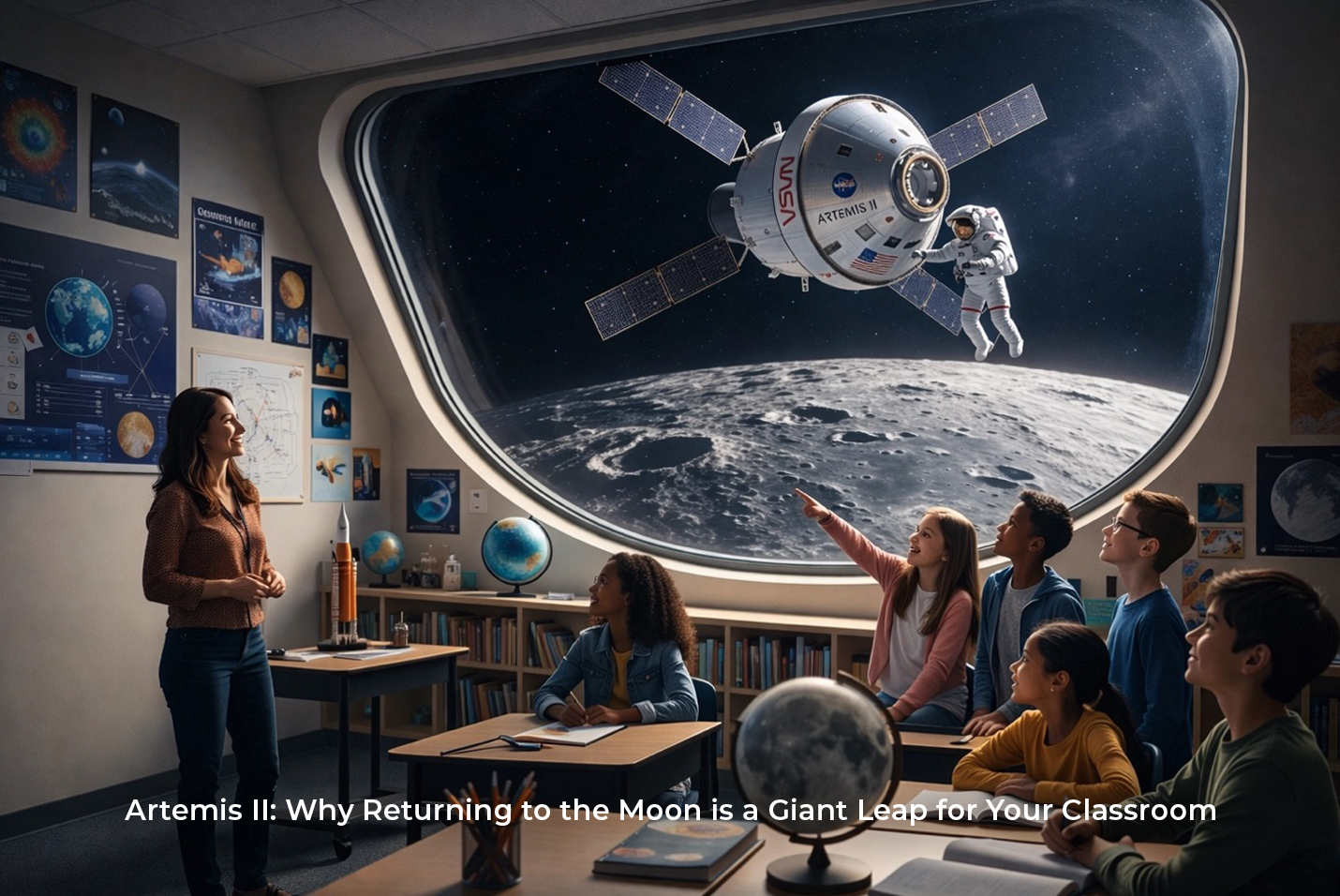
Just a few days ago, on April 10, 2026, the world watched the Orion spacecraft bob in the Pacific Ocean after its historic journey around the Moon. As the Artemis II crew, Reid Wiseman, Victor Glover, Christina Koch, and Jeremy Hansen, stepped back onto solid ground, they didn't just bring back data. They brought back a renewed sense of wonder that had been largely absent from our collective consciousness for over fifty years.
At the PAST Foundation, we often talk about "linking learning to life." Artemis II isn't just a NASA milestone; it marks a transformative moment for education by demonstrating how classrooms can mirror the ambition of space programs. Imagine a science class where students collaborate on an "Artemis Mission Challenge."
In this project, teams design a lunar habitat using simple materials, assume roles inspired by the Artemis crew, and tackle real-world mission issues such as energy, life support, and communication with Mission Control. By presenting their solutions, students directly experience how lunar exploration can inspire relevant, hands-on learning in every classroom.
The Dawn of the Artemis Generation
Today, we explore how this first crewed mission to the lunar vicinity since 1972 can reshape our approach to education. While the Apollo era was once the standard for inspiration, it is now ancient history for students. Artemis defines the "Artemis Generation": learners set to witness the establishment of a permanent human presence on the Moon and, eventually, the first steps on Mars.
This mission allows us to reimagine the boundaries of the traditional classroom. When we see Victor Glover become the first person of color and Christina Koch the first woman to venture into deep space, we aren't just reading about a "first" in a history book. We are seeing a mirror held up to our classrooms. Representation matters, and Artemis II has just handed every educator a powerful tool to tell their students: "There is a place for you in the future, regardless of your background."
Beyond the Textbook: Learning in Real-Time
What does it look like to move from theory to practice? For years, physics and orbital mechanics stayed confined to page 242 of a dusty textbook—until Artemis II. During the ten-day mission, students witnessed the "slingshot" effect firsthand, discovering that gravity isn't just a definition to memorize but a tool to harness as they moved 600,000 miles through the void.
This is the heart of educational innovation: making massive, complex concepts tangible. At PAST, we believe in a learner-centered environment where the world is the lab. For example, when the Artemis crew used 4K laser communication to send high-definition video back to Earth, they weren't just showing off technology; they were demonstrating the necessity of embedded electronics and smart design.
Imagine a student in a rural or urban district realizing that the coding or circuit-building they do in their local Fab Lab uses the same logic that keeps four humans alive in deep space. That realization is where agency is born.
But not every school has access to a Fab Lab or advanced technology—and that should not be a barrier. Agency begins with hands-on learning, resourcefulness, and curiosity. With simple materials like paper, tape, household recyclables, and basic circuits, students can design, build, test, and solve problems like the Artemis crew. For classrooms with limited resources, activities such as mission journals, cardboard engineering, and unplugged coding exercises can help foster innovation. The true power of the Artemis mission is that it invites every student, regardless of access or background, to see themselves as problem solvers and explorers.