
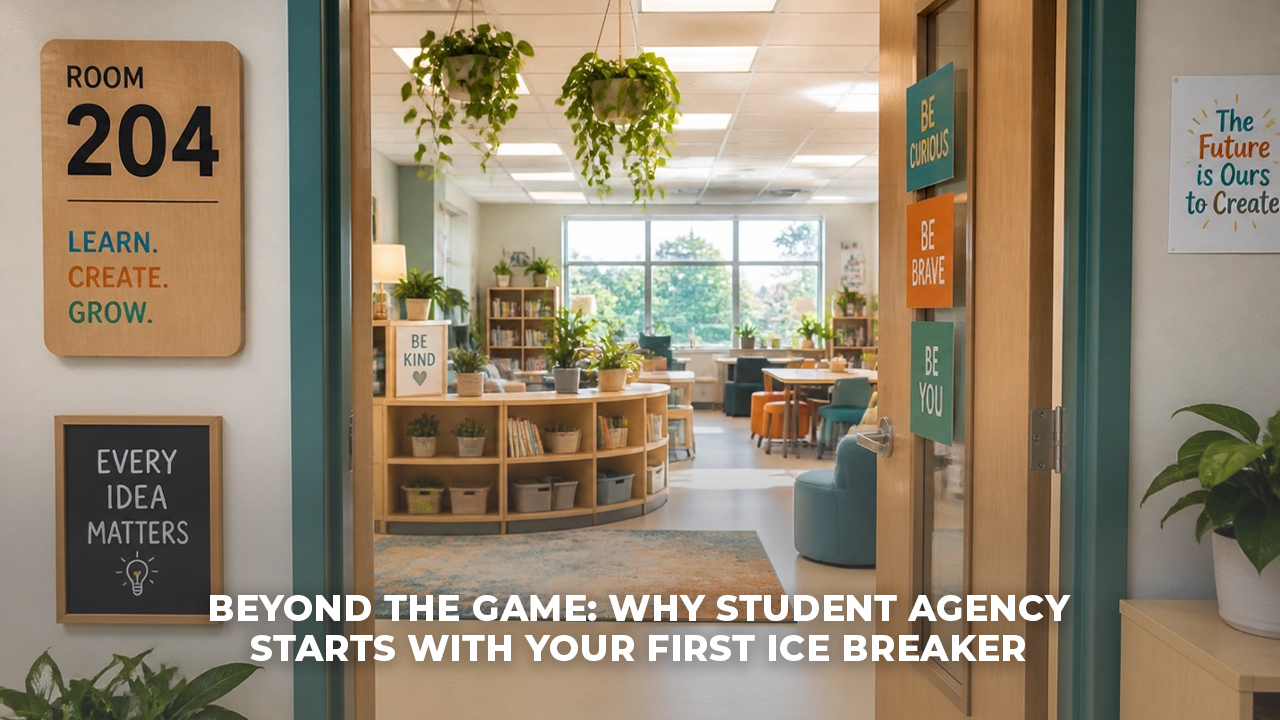
In this first installment of our Agency-First Classroom series, we’re diving into the summer daydream shared by every visionary educator: the perfect first day.
It’s June. The sun is out, the school hallways are quiet, and August feels like a lifetime away. But for those of us in the world of educational innovation, June is the ultimate "pro-move" month. It’s time to step back from grading and paperwork to ask the big questions. What if we reimagined the first ten minutes of school? What would it look like to transform a room full of strangers into a collaborative ecosystem before the first bell even stops ringing?
At the PAST Foundation, we believe the journey to transdisciplinary learning and real-world problem solving doesn’t start with your first project rubric. It starts with the very first activity you choose, the icebreaker.
The Hidden Curriculum of the First Ten Minutes
We’ve all been there. The "Human Bingo" sheets feel like a chore. The "Two Truths and a Lie" makes the introverts in the room want to vanish. While these activities are well-intentioned, they often miss a critical opportunity.
When a student walks into your classroom in August, they aren't just looking for their desk. They are subconsciously scanning the environment to answer three fundamental questions:
- Who has the power here? (Is this a "sit and get" environment, or do I have a say?)
- How safe is it to speak? (Is risk-taking rewarded or met with awkward silence?)
- How much of me is welcome in this space? (Do I have to leave my identity at the door?)
If our first interaction is a forced, superficial name game, we end up answering those questions with: "the teacher," "not very," and "only the parts that follow directions."
To build a culture of student agency, where learners take ownership of their education, we have to flip the script. We have to move beyond the name game and use our first moments together to activate student voice.
What is Student Agency, Really?
In the context of a learner-centered environment, agency is more than just "choice." It is the intentional design of a space where students have:
- Voice: Their unique perspectives and backgrounds shape the daily experience.
- Choice: There are multiple, meaningful pathways to participate and demonstrate mastery.
- Ownership: Students see the classroom as ours, not the teacher's.
When we talk about the "Agency-First Classroom," we are talking about a shift in the power dynamic. In a traditional setting, the teacher is the gatekeeper of knowledge. In a PAST Foundation-inspired, transdisciplinary setting, the teacher serves as a lead inquirer and facilitator. If we want students to tackle complex, real-world problems in October, we have to show them in August that their contributions matter.
The Transdisciplinary Connection
You might be wondering, “Annalies, it’s just an icebreaker. Why are we talking about transdisciplinary teaching?”
At the heart of the PAST philosophy is the idea that learning should be messy, collaborative, and connected to the real world. You cannot have a successful transdisciplinary project if your students are waiting for permission to think.
Real-world innovation requires a "Culture of Yes." It requires students who feel safe enough to fail, curious enough to ask "Why?", and confident enough to lead. If our icebreakers are scripted and rigid, we unintentionally train students to be passive. By designing for agency on Day One, we lay the foundation for the high-level critical thinking they’ll need for the rest of the year.
Why Typical Ice Breakers Often Fail the Agency
To reimagine the start of the year, we need to honestly examine why the "classics" sometimes fall short. Most traditional icebreakers suffer from a few common pitfalls:
- Forced Vulnerability
- Asking a student to share a "fun fact" or a personal story in front of 30 strangers is a high-stakes move. For many students, especially those from marginalized backgrounds or those dealing with social anxiety, this triggers an immediate "threat" response in the brain. Agency cannot thrive in a state of fight-or-flight.
- The Instructor as the Sun
- In many games, the teacher stands at the front, asks the questions, and validates the answers. The communication follows a hub-and-spoke model. Agency requires a web: where students talk to and learn from each other without the teacher constantly mediating the exchange.
- One-Size-Fits-All Participation
- If the only way to participate is to stand up and speak loudly, we’ve already excluded a significant portion of our learners. Agency means offering multiple modes of engagement: writing, sketching, digital interaction, or small-group sharing.
Four Pillars of Agency-Centered Ice Breakers
So, how do we fix it? How do we design activities that empower the next generation from the start? We use these four design principles as our North Star.
Pillar 1: Structured Choice
Instead of a single prompt, offer a menu. When you give a student the power to choose which part of their story to tell, you respect their autonomy. You are saying, "I trust you to decide what is relevant."
Pillar 2: Shared Authorship
The goal is to co-construct the classroom culture. Instead of handing out a list of "Classroom Rules," why not start with an activity in which students define what a "safe-to-fail" environment looks like to them? This shifts the classroom from a place they visit to a place they build.
Pillar 3: Low Risk, High Meaning
An activity should be easy to enter (low risk) yet yield information that actually impacts the class (high meaning). Knowing that a student likes pizza is low risk but also low meaning. Knowing that a student feels most confident when working in a small group is low-risk (if asked correctly) and high-meaning for how you design your first unit.
Pillar 4: Consequential Voice
This is the "secret sauce" of agency. If a student gives you feedback or shares a preference during an icebreaker, act on it. If the class collectively says they are nervous about public speaking, and you immediately adjust your first week’s schedule to include more pair-shares and fewer presentations, you have just demonstrated that their voices have the power to change their environment. That is the moment agency is born.
Preparing for August in June
We know that as educators and administrators, your "to-do" list is never-ending. But taking the time now, while the pressure of the daily bell schedule is off, to reflect on your culture-building strategy is the best investment you can make.
Think about your favorite STEM activities or the most successful projects you’ve run. What made them work? It was likely the trust and the "vibe" in the room.
What if this year, we treated the first week of school as a design challenge?
- What if the syllabus were something students helped edit?
- What if the seating chart were a collaborative puzzle they solved together?
- What if the first "icebreaker" was actually a micro-version of a transdisciplinary project?
Looking Ahead: Part 2
Building an "Agency-First" classroom doesn't happen by accident. It’s a deliberate, visionary act of leadership. By shifting our focus from "managing" students to "activating" learners, we create an environment where everyone can thrive.
In our next post, we’re going to get tactical. I’ll be sharing five specific, transdisciplinary icebreakers: complete with "Agency Moves" for each one. You can take them straight to your classroom this August. We’ll look at everything from "Human Bingo 2.0" to student-generated question circles.
In the meantime, we want to hear from you. How are you reimagining your classroom culture this summer? What hurdles are you facing in building student agency? Connect with us and let’s start the conversation.
The future of education is collaborative, and it starts with the courage to do things differently. Let’s move beyond the name game together.
Author: Annalies Corbin, PAST Foundation, USA



Responses