
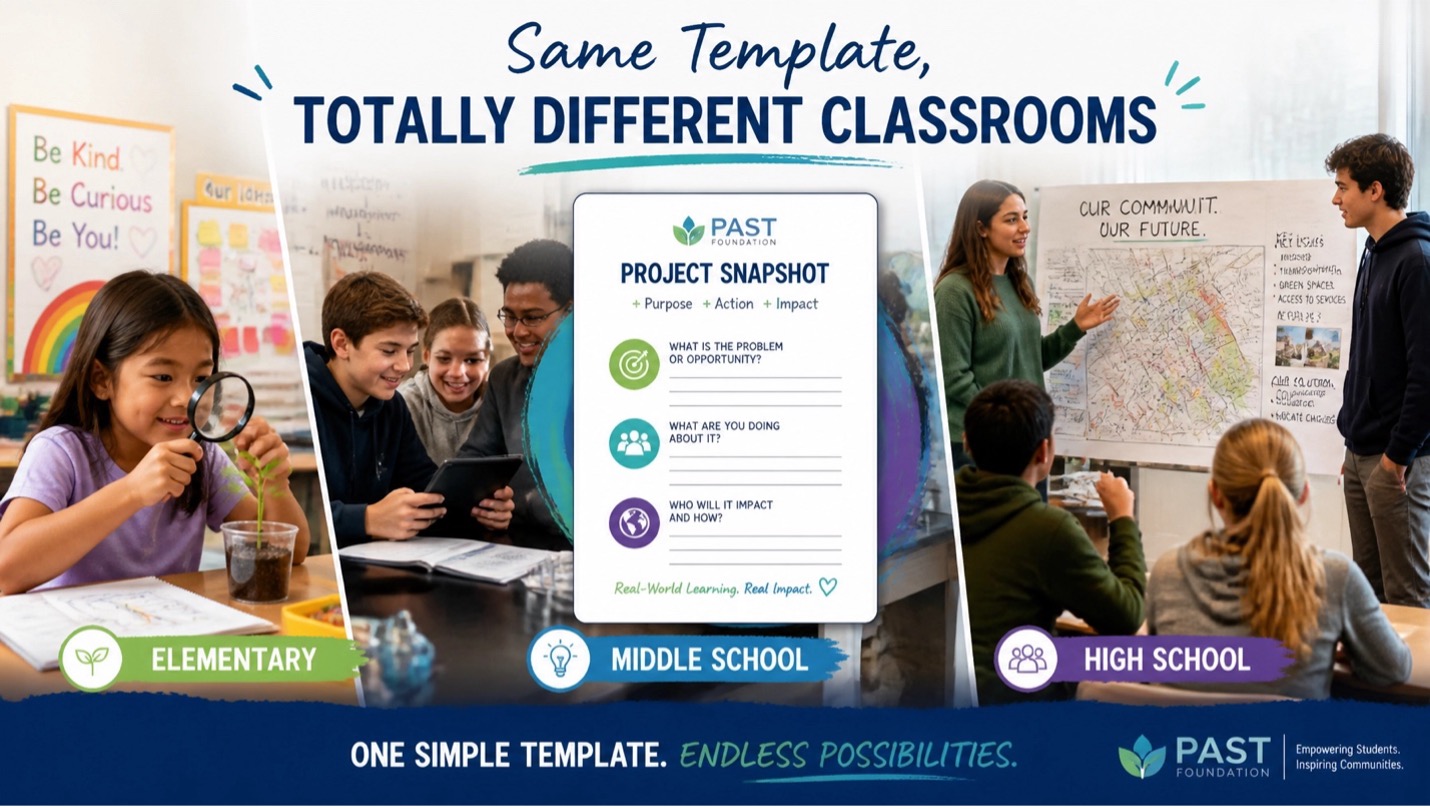
In the first part of this series, we pulled back the curtain on the Project Snapshot: our favorite "one-page wonder" for keeping Project-Based Learning (PBL) from turning into a chaotic free-for-all. We talked about why it works and how it acts as the nervous system for your classroom, keeping standards, activities, and assessments in perfect sync.
But a question we often hear during our teacher professional development sessions is: "Does this really work for my grade level?"
The answer is a resounding yes. Whether you’re teaching seven-year-olds the basics of biology or guiding seventeen-year-olds through the intricacies of urban policy, the Project Snapshot scales with your students. The magic lies in the Three-Tier Assessment Ladder: moving from Vocabulary to Compare & Contrast and finally to the Extended Answer.
Today, let’s look at what that looks like in practice. We’ve designed three concrete examples to show how one template can transform learning across the K-12 spectrum.
1. The Elementary Snapshot: Designing the "Perfect" Pollinator Garden
The Big Idea: Students explore the relationship between plants and local insects to design a garden that helps their community thrive.
At the elementary level, we focus on making the abstract tangible. This project leans heavily on Student Agency and Problem-Based Learning. By giving students the "choice and voice" to decide which pollinators they want to save, they become the drivers of the inquiry.
The Three-Tier Assessment in Action:
-
Vocabulary (Tier 1): Can the student correctly label the parts of a flower and identify "pollination," "habitat," and "nectar"? This ensures the foundational language is in place before they move to complex tasks.
-
Compare & Contrast (Tier 2): Students compare two different local insects (e.g., a honeybee vs. a monarch butterfly). What do they both need? What makes their habitat requirements different?
-
Extended Answer (Tier 3): "If our school garden only had one type of flower, how would that affect the local ecosystem? Support your answer with evidence from your observations."
By using this ladder, we ensure Mastery-Based Learning. We aren't just checking if they can draw a bee; we are checking if they understand the function of that bee within a system.
2. The Middle School Snapshot: The "Food Desert" Solution
The Big Idea: Students analyze their own neighborhoods to identify "food deserts" and design a mobile market or school garden store to increase access to fresh produce.
Middle school is the "bridge" years. Learners are ready to move from concrete observations to abstract analysis. This project is a prime example of Culturally Relevant Teaching and Transdisciplinary Learning. Students aren't just doing "math" or "social studies"; they are using both to solve a real-world problem that affects their families and neighbors.
The Three-Tier Assessment in Action:
-
Vocabulary (Tier 1): Students define terms like "food insecurity," "urban planning," "profit margin," and "logistics."
-
Compare & Contrast (Tier 2): Students analyze two different neighborhoods using GIS data. They compare the number of grocery stores versus convenience stores and the average distance a resident must travel for fresh fruit.
-
Extended Answer (Tier 3): "Propose a sustainable business model for a mobile market in Zone A. How does your design address the specific barriers of transportation and cost identified in your research?"
This tier requires students to synthesize data into a persuasive proposal, moving them toward the kind of workforce development programs and critical thinking skills they will need in the future.
3. The High School Snapshot: The Affordable Housing Initiative
The Big Idea: Students investigate the local housing crisis, looking at zoning laws, construction costs, and social impact to propose a development plan for a vacant lot in their city.
For high schoolers, the Project Snapshot becomes a professional-grade planning tool. This is deep Transdisciplinary Learning at its finest: integrating economics, civil engineering, ethics, and persuasive writing. This project prioritizes Mastery-Based Learning; the "final product" isn't just a grade, but a presentation that could theoretically be delivered to a City Council.
The Three-Tier Assessment in Action:
-
Vocabulary (Tier 1): Terms like "inclusionary zoning," "gentrification," "structural equity," and "mixed-use development."
-
Compare & Contrast (Tier 2): Students compare the long-term economic and social impacts of "high-density apartments" versus "tiny home villages" for a specific demographic (e.g., veterans or transition-age youth).
-
Extended Answer (Tier 3): "Construct an evidence-based argument for a specific zoning change in your district. How does your proposal balance the needs of current residents with the necessity of affordable growth?"
This level of work mirrors the complexity of the adult world. It moves beyond "schooling" and into the "human-centered learning" that the PAST Foundation champions.
Why This Matters for You
What do these three very different projects have in common? They all started on the exact same one-page document.
The Project Snapshot isn't about adding more to your plate; it’s about organizing what’s already there so you can focus on the heart of the work: connecting with your students. When you have a clear roadmap from Vocabulary to Extended Answer, you create a classroom where every student, regardless of their starting point, has a clear path toward mastery.
This is the work that transforms "just another school day" into a life-changing experiential learning activity.
Ready to Build Your Own Snapshot?
We know that seeing these examples is just the beginning. To truly transform your classroom, you need the tools, the templates, and the community to support you.
Join the PAST Foundation Resource Library.
Our new subscription model gives you exclusive access to our full suite of project-based learning resources, including:
-
Full K-12 unit plans aligned to the five Hacking School strategies.
-
Video deep-dives into mastery-based assessment strategies.
-
Direct access to the PAST coaching team.
[Click here to explore our subscription plans and start hacking school today!]
Together, we can reimagine what’s possible in the classroom. What will your next Snapshot look like?



Responses