
In this second part of our Agency-First Classroom series, we’re diving into the "how." In our last post, we explored why student agency is the secret sauce for a thriving classroom. But how do we actually spark that flame on Day One?
What if we reimagined the traditional, often cringe-worthy icebreaker? Instead of just asking for a favorite color or a "fun fact," what if we used those first precious hours to activate critical thinking, build transdisciplinary connections, and empower students to take ownership of their learning environment?
At the PAST Foundation, we believe every interaction is an opportunity to design a learner-centered environment. We don't just want students to know each other’s names; we want them to understand each other’s strengths, respect diverse perspectives, and see themselves as vital contributors to a collaborative ecosystem.
Here are five "ice breakers with purpose" designed to foster a culture of agency and inquiry from the moment your students walk through the door.
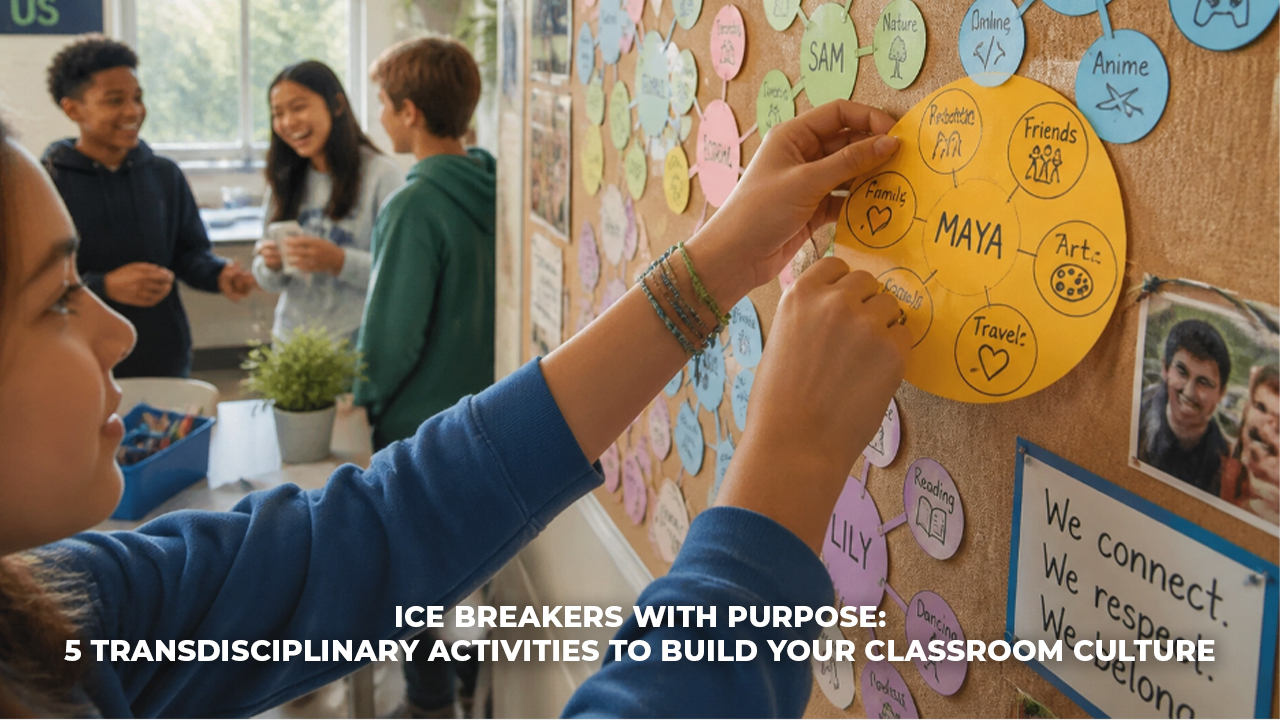
1. Identity Webs & The "We Are..." Wall
The Focus: SEL + ELA + Social Studies + Art
True agency starts with identity. When a student feels seen and valued for who they are, not just their test scores, they are more likely to take risks and engage deeply. This activity goes beyond surface-level traits to explore the complex layers of who we are.
The Process:
- Model the Vulnerability: Start by drawing your own web on the board. Include branches for family heritage, hobbies, languages spoken, and "superpowers" (such as being a great listener or a puzzle-solver).
- Creation: Give students space to map their own webs. Encourage them to use symbols, sketches, or words. This isn't just an art project; it’s a social studies exercise that helps them understand human geography and personal history.
- The Collaborative Synthesis: Instead of keeping these webs private, have each student contribute one "identity word" to a communal “We Are…” Wall.
Why It Works: This transforms the classroom from a room of strangers into a community of skateboarders, big sisters, bilingual poets, and future engineers. It signals that your classroom is a place where every story belongs.
2. Data About Us: The Human Stats Investigation
The Focus: Math + Data Literacy + Community Building
Who says math can’t be a social bridge? In this activity, we treat the classroom as a living laboratory. Students practice data collection and analysis while uncovering the fascinating patterns within their own peer group.
The Process:
- The Inquiry: Pose 3–5 questions. "How many languages are spoken at home?" "What is your preferred mode of learning (doing, watching, or reading)?" "How many miles do you travel to get to school?"
- Data Collection: Use sticky notes or digital tools to collect anonymous data points.
- Analysis & Visualization: Assign small groups to different data sets. Their task is to create a visual representation (a bar graph, a pictograph, or a frequency table) and write one "noticing" statement.
- The Gallery Walk: As students view the graphs, ask them to reflect: "What does this data reveal about our collective strengths? How can we use this information to support one another this year?"
The Impact: You’re teaching data literacy standards while normalizing differences. Students begin to see that "math" isn't an abstract concept confined to textbooks; it’s a tool for understanding their world and community.
3. Story of an Object: Culture & Curiosity Circles
The Focus: ELA + Social Studies + Speaking & Listening
We live in a world of stories. To build a culture of agency, students need to practice the art of storytelling and, more importantly, active, empathetic listening.
The Process:
- The Artifact: Ask students to bring in (or show a photo of) an object that holds personal significance. It could be a handed-down recipe, a worn-out soccer ball, or a piece of jewelry.
- Curiosity Circles: In groups of four, students share the "biography" of their object.
- Active Inquiry: We teach "Curiosity Stems" to help students move beyond "That’s cool." Encourage questions such as: "How does this object connect you to your family?" or "What did you have to learn to use this?"
The Impact: This bridges the gap between home and school. By integrating narrative speaking standards with cultural awareness, you establish a "Culture of Yes" that celebrates diverse backgrounds as assets. For more on fostering these environments, check out our Learning Unboxed podcast for deep dives with education innovators.
4. The Collaborative Challenge: Build & Explain
The Focus: STEM + ELA + Teamwork
If you want to know how a group will handle a complex project in November, watch how they handle a "tower of straws" in August. This activity makes the "invisible" skills of collaboration visible.
The Process:
- The Mission: Provide a simple, constrained challenge. Build a bridge that supports a specific weight or a tower that reaches a certain height, using only limited materials.
- Defined Agency Roles: Assign roles such as Materials Manager, Lead Designer, and Communications Director. This ensures everyone has a specific "lever" of agency to pull.
- The Debrief: The build is only half the fun. The real magic happens when groups explain their reasoning. Why did they choose that design? How did they resolve a disagreement?
The Impact: This is a mini-lesson in Design Thinking. You are introducing the engineering design process while simultaneously establishing the norms of professional communication and resilience training.
5. Our Class Agreements: From Values to Actions
The Focus: Civics + ELA + SEL
Traditional classroom rules are often a list of "don’ts" handed down by the teacher. Agency-first classrooms rely on "Agreements," a living document co-created by the community.
The Process:
- Reflection: Ask students to recall a time when they felt truly safe and successful in a group. What was happening then?
- Value Mapping: In small groups, students identify the values they want to guide their year (e.g., Respect, Focus, Risk-Taking).
- The Action Shift: This is the most important part. Move from vague values to concrete actions. If the value is "Respect," what does that look like in a heated debate? (e.g., "We wait for the other person to finish before speaking.")
- The Ratification: Once the class agrees on 4–6 statements, have everyone sign the document.
The Impact: This is democratic participation in action. When students help build the rules, they are far more likely to hold themselves and each other accountable. You aren't just managing a classroom; you’re facilitating a micro-society.
Sustaining the Momentum
These activities aren't one-and-done events. To truly transform your classroom culture, you have to revisit, iterate, and evolve. At the PAST Foundation, we call this the "Design Cycle" of teaching.
- Update the "We Are..." Wall mid-year as students grow and discover new interests.
- Run a New Data Survey when you start a new unit to see what students already know.
- Revisit the Class Agreements whenever the culture feels a bit shaky.
Reimagining the start of the school year requires a shift in mindset. It’s about moving from "What do I need to tell them?" to "What can we build together?"
If you’re looking for more ways to level up your teaching practice before the August bell rings, explore our Professional Development opportunities. We offer workshops and resources to help you transition from a traditional model to a visionary, transdisciplinary approach.
What does it look like to empower your students from day one? It means giving them the tools to speak, the space to lead, and the data to understand they are part of something bigger than themselves.
Together, let’s make this school year a journey of discovery. Ready to get started? Connect with us and let’s reimagine education together.
Author: Annalies Corbin, PAST Foundation, USA


Responses