
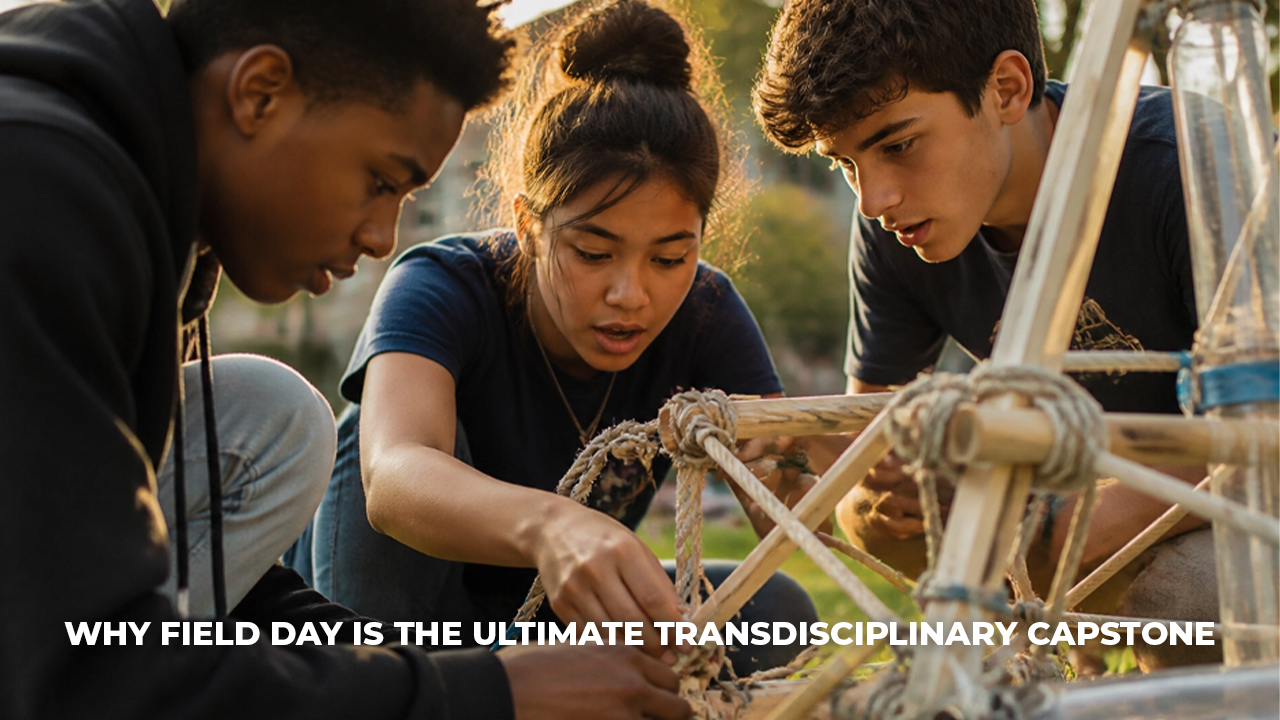
In this first installment of our new series, The Physics of Play, we dive deep into a tradition found in almost every school across the country: Field Day. You know the vibe: the smell of cut grass, the sound of whistles, the chaotic joy of relay races, and the inevitable orange slices.
For many educators, Field Day is seen as the "finish line" reward: a day to let off steam because the "real learning" is officially over for the year. But what if we’re missing the biggest opportunity of the semester? What if we stopped viewing Field Day as dessert and started seeing it as the ultimate transdisciplinary capstone?
At the PAST Foundation, we believe that learning shouldn't stop just because the weather turns warm and textbooks are closed. In fact, when students are moving, competing, and collaborating, they often do their most profound thinking. Today, we’re exploring how to leverage the "Field Day" experience to cement a year’s worth of learning through the lens of our Five Core Threads.
The Myth of "Just Fun"
It’s May. Educators are exhausted. Students have "summer brain." The temptation to just "get through the week" is real. We often treat these final outdoor events as a break from the classroom’s rigors. But when we silo "fun" away from "learning," we inadvertently tell students that education is a chore to be avoided.
Instead, let’s reimagine Field Day. Imagine a student standing at the start of a long jump. In their head, they aren't just thinking about the jump; they are calculating force, trajectory, and friction. They are practicing Mastery Learning in real time. By reframing these games as engineering challenges and physics experiments, we transform a simple afternoon into a high-impact learning lever.
Connecting the Five Threads to the Field
How do we make this transition from a day of games to a transdisciplinary capstone? We look to the framework that guides everything we do: The Five Core Threads.
- Student Agency: The Architects of Play
- Traditional Field Days are often "done to" students. Teachers set up the cones, explain the rules, and blow the whistle. To make this a capstone, we must shift the power. What if students designed the games?
- When students take the lead in designing a "Newtonian Relay Race" or a "Water-Balloon Ballistics Challenge," they exercise true Student Agency. They make decisions, troubleshoot logistics, and take ownership of the outcome. This isn't just about playing; it’s about the power of creation.
- Culturally Relevant Education: Building Community
- Field Day is a unique moment when the entire school community comes together. It’s an opportunity to ensure every student feels seen and valued. In this context, Culturally Relevant Education means designing challenges that are inclusive of all physical abilities and cultural backgrounds. It’s about celebrating the diverse ways our community moves and solves problems.
- Mastery Learning: The Lab is the Lawn
- How do we know a student truly understands the laws of motion? Is it because they passed a bubble test in March, or because they can adjust their center of gravity to win a tug-of-war?
- Field Day provides a "performance-based assessment" environment. When a student applies a concept learned in a textbook to a physical challenge on the field, that is Mastery Learning in its purest form. They aren't just reciting facts; they are demonstrating competency in a complex, dynamic environment.
- Transdisciplinary Teaching: Breaking the Silos
- This is where the magic happens. Field Day shouldn't be just the "PE Teacher’s Project." It is the ultimate playground for Transdisciplinary Teaching.
- Math: Calculating averages of team scores or measuring distances in the shot put.
- Science: Exploring the aerodynamics of a frisbee or the surface tension of a slip ‘n’ slide.
- Social Studies: Researching the history of the Olympic Games or indigenous sporting traditions.
- ELA: Writing persuasive arguments for why a specific game should be included or drafting "live" sports journalism pieces during the events.
- When we break down the walls between disciplines, the world becomes the classroom.
- This is where the magic happens. Field Day shouldn't be just the "PE Teacher’s Project." It is the ultimate playground for Transdisciplinary Teaching.
- Problem-Based Learning (PBL): The Ultimate Challenge
- Every Field Day station is essentially a mini PBL unit. "How do we get this egg from Point A to Point B without it breaking, using only these materials?" That is a classic engineering problem. By framing these activities as Problem-Based Learning, we encourage students to iterate, fail forward, and find creative solutions under pressure.
Why a "Capstone" Matters
A capstone is meant to be a crowning achievement: a moment that integrates everything a student has learned throughout a course of study. By positioning Field Day as a capstone, we give the end of the year a sense of purpose.
Think about the work - we are constantly seeking ways to bridge the gap between school and the real world. In the professional world, problems aren't solved in 45-minute increments while sitting at a desk. They are solved through movement, collaboration, and iterative testing.
Field Day more closely mirrors the "real world" than a final exam ever could. It demands grit, teamwork, and the ability to think on your feet. When we recognize this, we empower our students to see themselves as more than "test-takers." We see them as problem-solvers.
Re-energizing the Exhausted Educator
We hear you: the end of the year is tough. Teachers are running on fumes. The beauty of the Field Day Capstone model is that it lightens the instructional load by tapping into students' natural energy.
Instead of fighting the "summer itch," we're scratching it. We're channeling that restless energy into a productive, transdisciplinary experience. You don't need a 50-page lesson plan to teach the physics of a relay race; you just need a few batons and a prompt that asks: "What is the most efficient way to transfer momentum?"
The best learning environments are the ones where the teacher acts as a facilitator rather than a gatekeeper of information. Field Day is the perfect place to practice that shift.
Moving Toward the Finish Line
What if we stopped saying "Have a great summer" and started saying, "Look at what you’ve built this year"?
Field Day is more than a tradition; it’s a canvas. It’s an opportunity to prove that learning is a lifelong, 360-degree experience. It’s a chance to show our students that the physics, math, and social dynamics we’ve discussed all year aren't confined to the four walls of the school building: they are out on the field, in the air, and in the way we work together.
As we wrap up this first part of The Physics of Play, we invite you to view your school’s end-of-year plans through a new lens. How can you leverage the fun to reinforce learning? How can you turn the "last day" into the "best day" for student growth?
In Part 2 of this series (coming this Thursday!), we're going tactical.
We’ll provide specific, grade-level-appropriate Field Day challenges that incorporate the Five Kevlar Threads and turn your playground into a laboratory.
From elementary "Levers and Pulleys" races to high school "Statistical Analysis" of the final standings, we’ve got the blueprints you need to make this year’s Field Day legendary.
Until then, keep reimagining what's possible. The field is waiting!
Author: Annalies Corbin, PAST Foundation, USA


Responses