
One Tiny Equation, One Enormous Lesson: What E=mc² Teaches Us About Scale
Author: Annalies Corbin, Ph.D., PAST Foundation, Columbus, Ohio, USA
Big idea: Small inputs can create enormous change
In November 1905, Albert Einstein published a short paper that introduced one of the most recognizable equations in modern science: E = mc².
The equation is often presented as a shorthand for explosive energy. But its deeper lesson is about scale. A very small amount of mass can represent an enormous amount of energy because it is multiplied by the speed of light squared.
That idea gives us a powerful doorway into learning:
> What looks small is not always insignificant. The conditions surrounding an input determine how much energy, impact, or possibility it can generate.
In a classroom, the “small” input might be a student’s question, a family story, a local observation, or ten minutes of authentic investigation. The resulting energy might be a new understanding, a stronger sense of agency, or a solution that improves part of the school community.
What if we stopped measuring the value of learning by how much content we cover and started asking what that learning makes possible?
Why it matters: Scale is both a scientific concept and a learning habit
Einstein’s original paper explored the relationship between a body’s energy content and its inertia. In modern form, E = mc² describes rest energy: mass and energy are related, and the squared speed of light creates an extraordinarily large conversion factor (Einstein, 1905).
Students do not need to master relativity before they can wrestle with the essential concept. They can begin by asking:
-
What changes when we zoom in or out?
-
Which small actions create larger effects?
-
What resources already exist in our classroom, school, or community?
-
What conditions help those resources become more powerful?
-
Who gets to decide what counts as valuable energy, knowledge, or expertise?
These questions move learning beyond isolated facts and toward systems thinking. Students begin to see that outcomes are shaped not only by individual parts, but also by relationships, feedback loops, structures, and context (Meadows, 2008).
This is where transdisciplinary learning and problem-based learning become especially valuable. A meaningful problem does not stay inside one subject area. Students may need mathematics to measure change, science to explain it, social studies to understand its history and consequences, language arts to communicate with stakeholders, and design thinking to develop and test a response.
Research on project-based learning has found positive effects on academic achievement, particularly when students engage with sustained, meaningful tasks rather than completing disconnected activities (Chen & Yang, 2019). Design thinking adds a human-centered process: empathize, define, ideate, prototype, test, and revise. It gives students a way to transform curiosity into action (Razzouk & Shute, 2012).
The equation, then, is not a formula for calculating classroom impact. It is a provocation:
> How might we increase the conditions that help a small amount of learning generate substantial understanding and meaningful change?
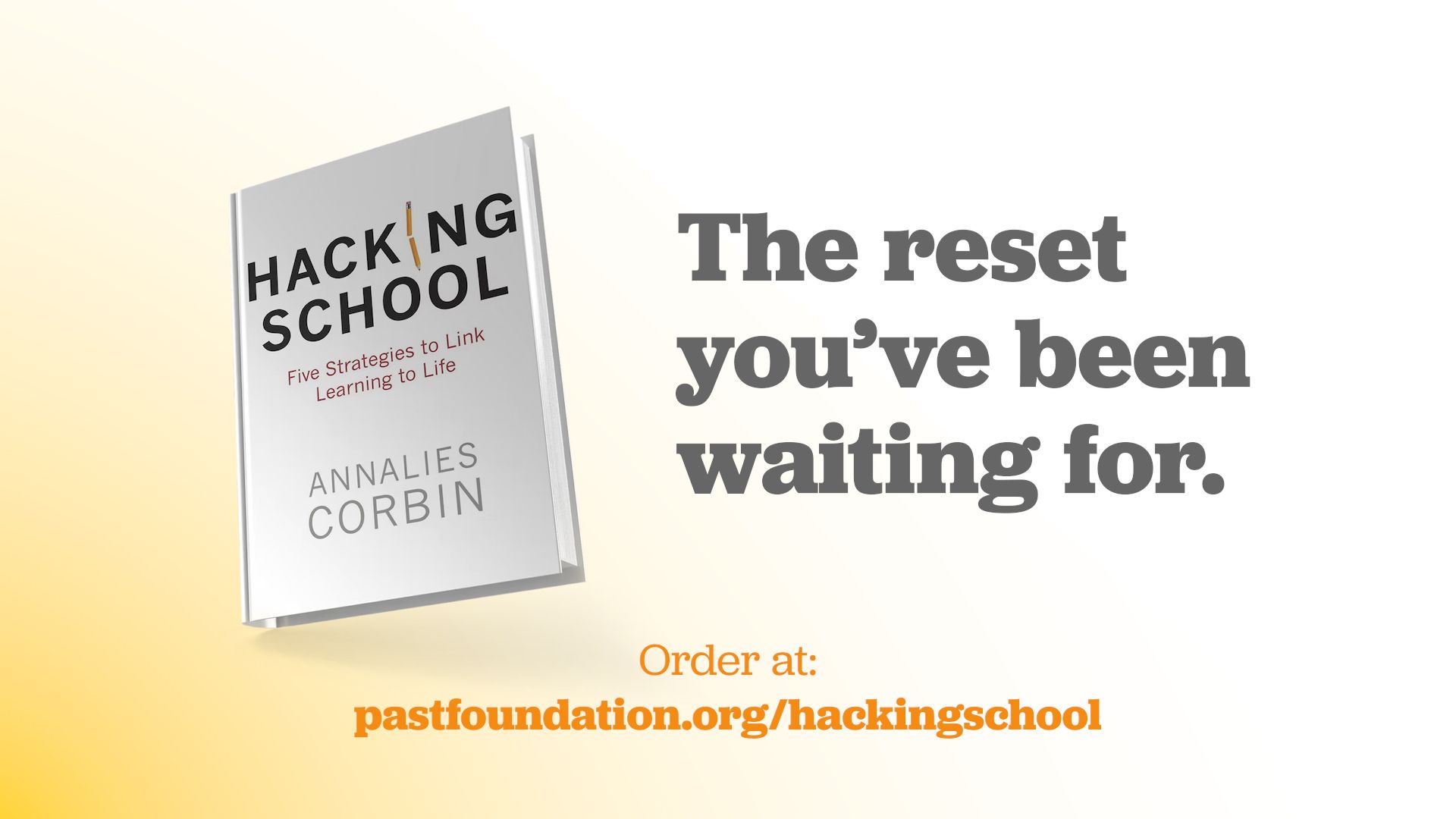
At PAST Foundation, this question connects directly to the five Hacking School pillars:
-
Student Agency: Learners help choose the questions, problems, and products that matter.
-
Culturally Relevant Teaching and Learning: Students’ lived experiences, languages, histories, and communities count as knowledge.
-
Mastery-Based Learning: Students have opportunities to revise, practice, and demonstrate growing understanding.
-
Transdisciplinary Learning: Knowledge moves across subject boundaries to address complex questions.
-
Problem-Based Learning: Learning begins with a meaningful challenge rather than ending with one.
The research on culturally relevant pedagogy reminds us that academic success, cultural competence, and critical consciousness belong together (Ladson-Billings, 1995). Culturally sustaining pedagogy builds on this work by asking schools to protect and build on students’ linguistic and cultural pluralism (Paris, 2012).
In other words, the “mass” students bring with them is not a deficit to overcome. It includes assets: experience, insight, relationships, creativity, and ways of making sense of the world.
One example: A school energy challenge at three levels
Imagine that students notice their school uses energy inefficiently. Lights remain on in empty rooms. Classroom temperatures vary widely. Some spaces feel comfortable, while others are too warm or too cold. Students wonder whether a small redesign could make the building more efficient and more welcoming.
The problem is broad enough to invite investigation but focused enough to support action:
> How might we help our school use energy more wisely while improving the learning environment for everyone?
The same challenge can become a developmentally appropriate learning experience across grade bands.
Elementary school: Notice, measure, and explain
Elementary students might begin by walking through the school with clipboards and observing where lights, fans, or screens are in use. They can create simple tally charts, compare occupied and unoccupied spaces, and measure temperature in different classrooms.
Students might interview classmates and staff:
-
Which spaces feel most comfortable?
-
When do we notice lights being left on?
-
What helps us remember to conserve energy?
-
What would make a reminder feel helpful rather than bossy?
In science, students explore light and heat. In mathematics, they represent data with graphs. In language arts, they write persuasive letters or create announcements. In art, they design signs that reflect the school’s languages, symbols, and community identity.
The design-thinking process remains accessible:
-
Notice what is happening.
-
Listen to the people affected.
-
Choose one focused problem.
-
Create a small solution.
-
Test whether it helps.
Mastery does not mean every student produces the same final product. It might mean demonstrating the ability to collect reliable observations, represent data accurately, explain a pattern, and use evidence to justify a recommendation.
Middle school: Map the system and identify leverage points
Middle school students can take the same problem further by mapping the school’s energy system.
They might investigate:
-
How electricity enters and moves through the building
-
Which systems consume the most energy
-
How schedules affect usage
-
Who controls lighting, heating, and cooling decisions
-
How energy costs affect the school budget
-
Whether conservation practices affect students differently in different spaces
Students can build a causal loop diagram showing how temperature, ventilation, student comfort, teacher decisions, and building systems interact.
They may discover that a simple “turn off the lights” campaign is not enough. Perhaps a room’s lights must remain on for safety. Perhaps students cannot reach the controls. Perhaps one classroom has limited natural light. Systems thinking helps students move from blaming individuals to understanding structures.
Teams could prototype a solution such as a student-designed classroom energy audit, a shared dashboard, or a revised room-use routine. They would collect feedback, revise their design, and present evidence to school leaders.
Here, student agency becomes real because students are not merely completing a simulation. They are investigating a problem that affects their daily lives and proposing a change to the people who can help implement it.
High school: Analyze tradeoffs and advocate for change
High school students might examine the challenge through physics, environmental science, economics, civics, and communications.
They could compare:
-
Energy use across different zones of the building
-
The cost and potential return of efficiency upgrades
-
The environmental effects of current practices
-
The relationship between building conditions and student concentration
-
The needs of students with sensory or health considerations
-
The distribution of benefits and burdens across the school community
Students may engage facilities staff, families, administrators, and local experts as co-researchers. They could create a proposal for occupancy sensors, improved insulation, window coverings, revised scheduling, or a student-led monitoring system.
Their final product might include a mathematical model, an evidence-based policy brief, a prototype dashboard, and a public presentation. Assessment can focus on mastery of specific competencies:
-
Explain energy transfer and conservation.
-
Interpret and communicate quantitative evidence.
-
Identify relationships within a complex system.
-
Consider stakeholder perspectives and equity.
-
Develop, test, and revise a feasible solution.
-
Defend a recommendation using evidence.
The smallest student contribution may be a single observation or question. But placed inside a collaborative ecosystem with strong feedback, authentic audiences, and opportunities for revision, that contribution can generate considerable learning energy.
That is the larger lesson of E = mc²: scale depends on relationships. A small input does not operate in isolation.
One reflection question
Where in your classroom or school might a small amount of student knowledge, agency, or community wisdom create a much larger impact if the conditions were designed to support it?
Try This
Choose one ordinary school phenomenon: a dark hallway, a crowded dismissal area, unused food, a noisy transition, or a confusing sign.
Ask students:
> What is happening, who is affected, and what small change could we test first?
Give them ten minutes to observe, one question to investigate, and one decision they can influence. Then listen closely to what they notice.
Continue the conversation Thursday
This Tuesday, we are using E = mc² as a lens for thinking about scale, potential, and systems. On Thursday, subscribers will receive the implementation guide: a step-by-step plan for turning the idea into a transdisciplinary problem-based learning experience.
The guide will include elementary, middle, and high school adaptations; a design-thinking sequence; mastery-based learning targets; stakeholder interview prompts; a systems-mapping protocol; and a before-and-after example you can adapt for your own learning environment.
What if the next powerful learning experience does not require a larger unit, more technology, or another initiative?
What if it begins with one small question, and the right conditions for that question to generate energy?
References
Chen, C.-H., & Yang, Y.-C. (2019). Revisiting the effects of project-based learning on students’ academic achievement: A meta-analysis investigating moderators. Educational Research Review, 26, 71–81.
Einstein, A. (1905). Ist die Trägheit eines Körpers von seinem Energieinhalt abhängig? Annalen der Physik, 18, 639–641.
Kulik, C.-L. C., Kulik, J. A., & Bangert-Drowns, R. L. (1990). Effectiveness of mastery learning programs: A meta-analysis. Review of Educational Research, 60(2), 265–299.
Ladson-Billings, G. (1995). Toward a theory of culturally relevant pedagogy. American Educational Research Journal, 32(3), 465–491.
Meadows, D. H. (2008). Thinking in systems: A primer. Chelsea Green Publishing.
Paris, D. (2012). Culturally sustaining pedagogy: A needed change in stance, terminology, and practice. Educational Researcher, 41(3), 93–97.
Razzouk, R., & Shute, V. (2012). What is design thinking and why is it important? Review of Educational Research, 82(3), 330–348.



Responses