
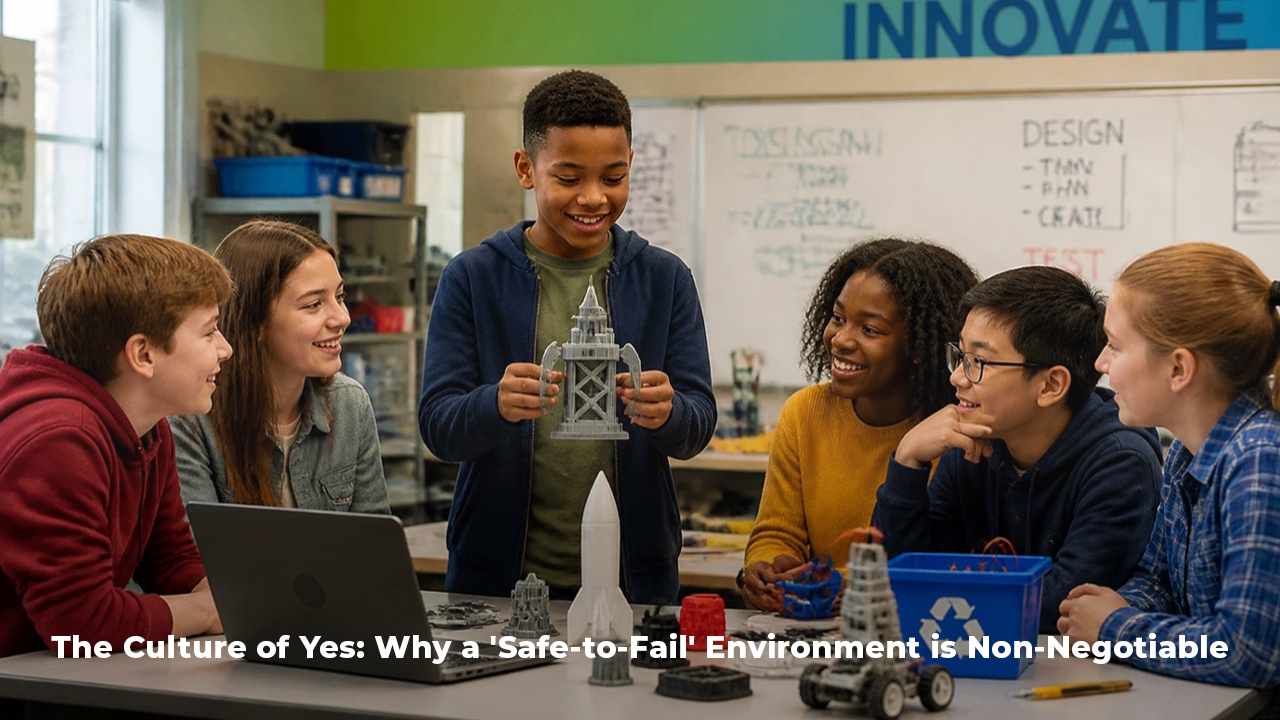
In this third week of our June series on prepping for the new school year, we’re joined by a radical idea that often feels counterintuitive in the high-stakes world of modern education: the "Culture of Yes."
We’ve already explored how to spark student agency and how to design the physical and mental spaces of your classroom. But even with the best layout and the most eager students, everything hinges on the invisible atmosphere you create. We sit down with the philosophy of the "Culture of Yes," a framework in which curiosity is the default and "safe-to-fail" isn't just a buzzword but a lived experience.
At the PAST Foundation, we believe that to reimagine teaching and learning, we must first dismantle the "Culture of No" that often governs our schools.
What Does a 'Culture of Yes' Actually Look Like?
When we talk about a "Culture of Yes," we aren't suggesting a classroom without boundaries or a "yes-man" approach to every student's whim. Rather, it is a stance of curiosity and possibility. Borrowed from improvisational theater, the core principle is "Yes, and..."
In a traditional classroom, a student's off-the-wall idea might be met with, "No, we don't have time for that," or "No, that’s not in the curriculum." In a Culture of Yes, that same idea is met with affirmation: "Yes, that’s an interesting angle. How could we connect it to the physics problem we’re solving?"
Why 'Yes' is the Most Powerful Word in the Room
- It Activates Agency: When a student hears "yes," they realize their voice has weight. It shifts them from being a passive recipient of information to a co-designer of their education.
- It Removes Friction: A "yes" removes unnecessary barriers that often stifle innovation. It signals trust.
- It Builds Partnerships: It transforms the educator from a gatekeeper of knowledge into a collaborative partner in discovery.
The Mechanics of a 'Safe-to-Fail' Environment
You can’t have a Culture of Yes without a safe-to-fail infrastructure. If students are terrified of receiving a low grade on their first attempt, they will never take the risks necessary for authentic transdisciplinary learning.
What does it look like to make failure "safe"? It means designing learning experiences with low stakes but high learning. In our Fab Lab and STEM programs, we see this every day. A student designs a 3D model, it fails to print correctly, and instead of a "grade," they get a "data point."
Key Takeaways for Building Safety:
- Frame Failure as Data: Use language that normalizes iteration. Ask "What did this attempt teach us?" rather than "Why did this fail?"
- Public Iteration: Share your own "works in progress" as an educator. When students see you refine an idea or admit a mistake, it gives them permission to do the same.
- Formative Over Summative: Prioritize frequent check-ins and prototypes rather than a single, high-stakes final project.
The Non-Negotiable Link to Student Agency
What if we stopped viewing students as "problems to be managed" and began seeing them as "talent to be activated"?
A Culture of Yes is the fertile soil in which agency grows. When we empower students to influence decisions, from project formats to classroom norms, we prepare them for the real world. In the workforce, success isn't about following a rubric; it's about identifying a problem, proposing a solution, and having the grit to see it through.
Together, we explore how this shift in power dynamics transforms the classroom. The teacher becomes a coach, kneeling to examine a messy prototype and asking, "What if we tried...?" rather than standing at the front of the room to provide the "right" answer. This human-centric approach builds the confidence and resilience students need to thrive in a rapidly changing world.
Transforming Your Practice with PAST Foundation
Creating a Culture of Yes isn't something you do overnight. It’s a practice that requires coaching, support, and a community of like-minded innovators.
At the PAST Foundation, we are committed to helping you activate this transformation. Whether through our professional development courses or our direct school coaching, we help administrators and educators move from "No, because..." to "Yes, and..."
How to Start Your 'Yes' Journey This August:
- Audit Your 'No's': For one day, keep a tally of how often you say "no" or "but." Look for opportunities to say "yes, and."
- Redefine the 'First Attempt': Rename your first draft or initial prototype to "Alpha Testing" or "v1.0" to signal that iteration is expected.
- Co-Create the Rubric: Sit down with your students and ask, "What does success look like for this project?" Invite them to the design table.
A Vision for the Future Learning Ecosystem
Imagine a school where the walls are writable, the furniture is modular, and the air is thick with the sound of "What if?" This is the learning ecosystem we are building together.
What does it look like to truly trust the next generation? It looks like saying "yes" to their curiosity. It looks like building a space where they can stumble without falling, and where every "failure" is just a springboard to a better design.
As you prepare for the upcoming school year, we invite you to be the catalyst for change. Let’s make the "Culture of Yes" the standard, not the exception. Are you ready to reimagine what’s possible?
Together, let's transform education. One 'yes' at a time.
Author: Annalies Corbin, PAST Foundation, USA


Responses