
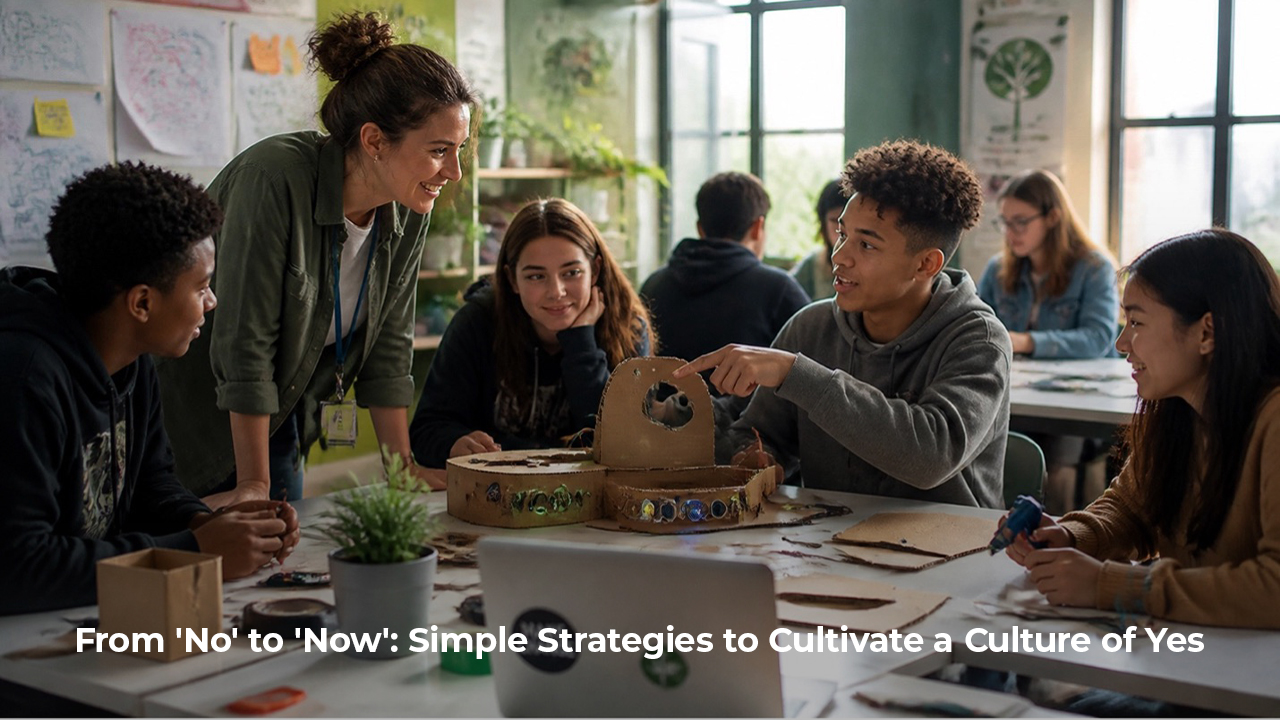
In this episode of our "Culture of Yes" series, we’re joined by a transformative idea: what if the primary response to student curiosity were not a gate but a bridge?
Last week, we explored the "why" behind building a culture of radical affirmation. We discussed that a "Culture of Yes" isn't about chaos or a lack of boundaries; it’s about creating a learner-centered environment where every student feels their ideas are a valuable part of the collective discovery. Today, we sit down with the "how." How do we move from the reflexive "no" to the generative "now"? How do we reimagine our daily interactions to empower students to take the bold risks necessary for true STEM innovation?
Together, we’re going to explore practical strategies, linguistic shifts, and simple routines that transform the classroom into a collaborative ecosystem where curiosity doesn't just survive but thrives.
The Gravity of 'No' and the Lift of 'Yes'
As educators, our days are defined by constraints: bells, curriculum standards, safety protocols, and the clock. In that high-pressure environment, "no" becomes a survival strategy.
- "No, we don't have time for that side project."
- "No, that's not quite the right answer."
- "No, we need to stay on this page."
While these responses often stem from management, their cumulative effect can be a slow erosion of student agency. When a student’s "What if?" is met with a "No, because...", the curiosity muscle begins to atrophy.
A Culture of Yes flips the script. It draws on the core principle of improvisational theater: "Yes, and..." In improv, if your partner says, "Look, a dragon!" and you reply, "No, it's just a kite," the scene dies. But if you say, "Yes, and it’s breathing blue fire!" the story takes flight.
In the classroom, "Yes, and..." is a commitment to treating every student contribution as a prototype, a beginning rather than an end.
The Script Shift: From Traditional to Transdisciplinary
Transforming your classroom culture starts with the language you use in the small, "in-between" moments. It’s about shifting from a gatekeeper mentality to a co-designer mentality.
Here is how you can begin shifting your scripts today:
- Reframing the "Wrong" Answer
- When a student offers an answer that is factually incorrect or off-base, the traditional response is a polite "No" or "Does anyone else have a different idea?" Instead, try validating the cognitive risk.
- Instead of: "No, that’s not the right formula."
- Try: "Yes, I see the logic in how you’re connecting those two variables. Let’s look at what happens to the data when we apply this third variable. What shifts?"
- By starting with "Yes," you acknowledge the student’s thinking. By adding "And," you invite them to continue the investigation with you.
- When a student offers an answer that is factually incorrect or off-base, the traditional response is a polite "No" or "Does anyone else have a different idea?" Instead, try validating the cognitive risk.
- Handling the "Ambitious" Request
- Students often have ideas that are grander than our current resources allow. Rather than shutting down that ambition, "Yes, and..." lets you scale the idea into something actionable.
- Instead: "No, we can’t build a full-sized robot this week.
- Try: "Yes, I love the ambition of a full-scale build. Since we have three days, what is the most critical component we could prototype by Thursday?"
- Students often have ideas that are grander than our current resources allow. Rather than shutting down that ambition, "Yes, and..." lets you scale the idea into something actionable.
This approach preserves the student's vision while teaching them the "heart of the work" in design thinking: iterative prototyping and managing constraints. This is the same mindset we emphasize in our Hacking School framework.
Strategies to Activate Curiosity and Risk-Taking
Beyond language, we must design the mental space where students feel safe failing. If we want a resilient and innovative workforce, we must normalize the "productive struggle."
The "I Like, I Wish, What If?" Feedback Frame
This is a staple of many of our Professional Development sessions at the PAST Foundation. It replaces traditional grading or critique with a growth-oriented conversation.
- I Like: Affirm what is working. "I like how you structured the user interface."
- I Wish: Identify a challenge without judgment. "I wish the transition between screens were a bit smoother."
- What If: Open the door to future innovation. "What if we used a voice-command feature here?"
This frame encourages both the teacher and the students to adopt a "Yes, and..." mindset. It ensures that feedback is not a "no" to the current work but a "yes" to the work’s potential.
Normalize the "Favorite Mistake"
What does it look like to celebrate a wrong turn? Try a 5-minute daily routine called "The Favorite Mistake." Invite a volunteer to share something they tried that didn't work.
Use the script: "Yes, that was a bold attempt, and because of it, we now know [X] won't work, saving us time in the next phase." When students see that the teacher values the lesson learned from a mistake as much as the "correct" result, the fear of "no" evaporates.
Gamifying the 'Yes': Classroom Routines
If you or your students find yourselves stuck in a "no" rut, use these improv-based games to reset the energy. They are quick, low-stakes, and effectively "activate" the collaborative parts of the brain.
Activity: "Yes, Let's!" (3 Minutes)
This is a high-energy transition tool. One person suggests a simple action ("Let's pretend we're astronauts walking on the moon!"). The entire class responds in unison, "YES, LET'S!" and performs the action for ten seconds. Another person then suggests something else.
The goal isn't just movement; it’s the visceral experience of a community saying "yes" to an idea without hesitation.
Activity: The "What If" Chain
In a STEM context, perhaps while discussing Embedded Electronics, pose a provocative question.
- "What if every building in the city were powered solely by the movement of the people inside?"
- Each student must add to the chain, starting with "Yes, and if that were true, we would also need..."
Managing Reality Without Killing Momentum
We are often asked: "But Annalies, I can't say 'yes' to everything. What about safety? What about the law?"
Authority and a "Culture of Yes" can coexist. You can remain authoritative while staying humble and inquisitive. When a constraint is non-negotiable, use the "Yes, and within our limits..." approach.
- "Yes, testing this outdoors would be ideal. Since it’s raining, let's brainstorm how we can simulate those conditions in the lab."
- "Yes, I hear your frustration with the school policy. While that’s a rule we must follow today, how could we design a presentation to the administration to propose a change for next semester?"
This teaches students that constraints are not "nos"; they are simply the parameters of the design challenge.
From 'No' to 'Now'
When we cultivate a Culture of Yes, we are doing more than making the classroom "nicer." We are building grit, confidence, and a sense of agency that students carry into their careers. We are preparing them for a world where the answers aren't in the back of a book but in the collaborative ecosystem they build with others.
What does it look like to start your next class with a "Yes"? What if we treated every student's curiosity as the spark for the next great breakthrough?
The transition from "No" to "Now" doesn't require a complete curriculum overhaul; it just requires the courage to say "Yes, and..." to the brilliance right in front of you.
Author: Annalies Corbin, PAST Foundation, USA


Responses