
Welcome back to our June prep series! In this episode of our "Designing the Space" series, we’re diving into the heartbeat of the educational experience: the environment. Last week, we discussed student agency and setting the tone with those first-day icebreakers. This week, we’re shifting our focus to the "where" and the "how."
As we move through June, it’s the perfect time to sit down with a cup of coffee and reimagine what your classroom does. Is it a container for compliance or a launchpad for discovery? At the PAST Foundation, we believe that transdisciplinary learning, which tackles real-world problems across multiple subjects, requires a radical rethink of both our physical surroundings and our internal mindsets.
What if your classroom wasn't just a place where students sat, but a place where they thrived? What if the walls, the desks, and even the "vibes" of the room were active participants in learning? Together, we’re going to explore how to bridge the gap between mental and physical spaces to create an environment where inquiry is the default setting.
The Mental Architecture: Building a Culture of "Yes"
Before you move a single desk or buy a new set of bins, we need to talk about the mental space. You can have the most high-tech makerspace in the world, but if the culture is still rooted in "one right answer" and "don't make a mess," learning will remain siloed.
Designing the mental space means cultivating mindsets that favor curiosity over correctness. In a transdisciplinary world, the problems students solve are messy. They don’t fit neatly into a 45-minute math block or a 50-page science textbook. To prepare them for this, we need to normalize the phrase, "I don’t know yet, but let’s find out."
Normalizing Uncertainty
When we shift to a discovery-based model, we move the teacher from the "sage on the stage" to the "guide on the side." This requires a significant mental shift for you and your students. Over the summer, consider how you can model your own learning. Maybe you’re exploring Embedded Electronics and Smart Design or diving into research on school design. Sharing your "Aha!" moments and failures with students builds a bridge of authenticity.
Psychological Safety and Belonging
Transdisciplinary work is inherently social. It requires students to critique one another’s ideas, collaborate on prototypes, and navigate disagreements. None of that happens without psychological safety. Designing for discovery means creating a mental space where students feel safe being wrong. This isn’t just "soft skills": it’s the heart of the work. It’s about building a learner-centered environment where variability is celebrated, not managed.
The Physical Layout: Breaking the "Front of the Room"
Once the mindset is in place, the physical environment needs to support it. If you tell students their voices matter but all the desks are bolted to the floor facing a podium, you’re sending a mixed message. Traditional classrooms are optimized for passive listening, whereas discovery-based classrooms are optimized for action.
The Power of Zones
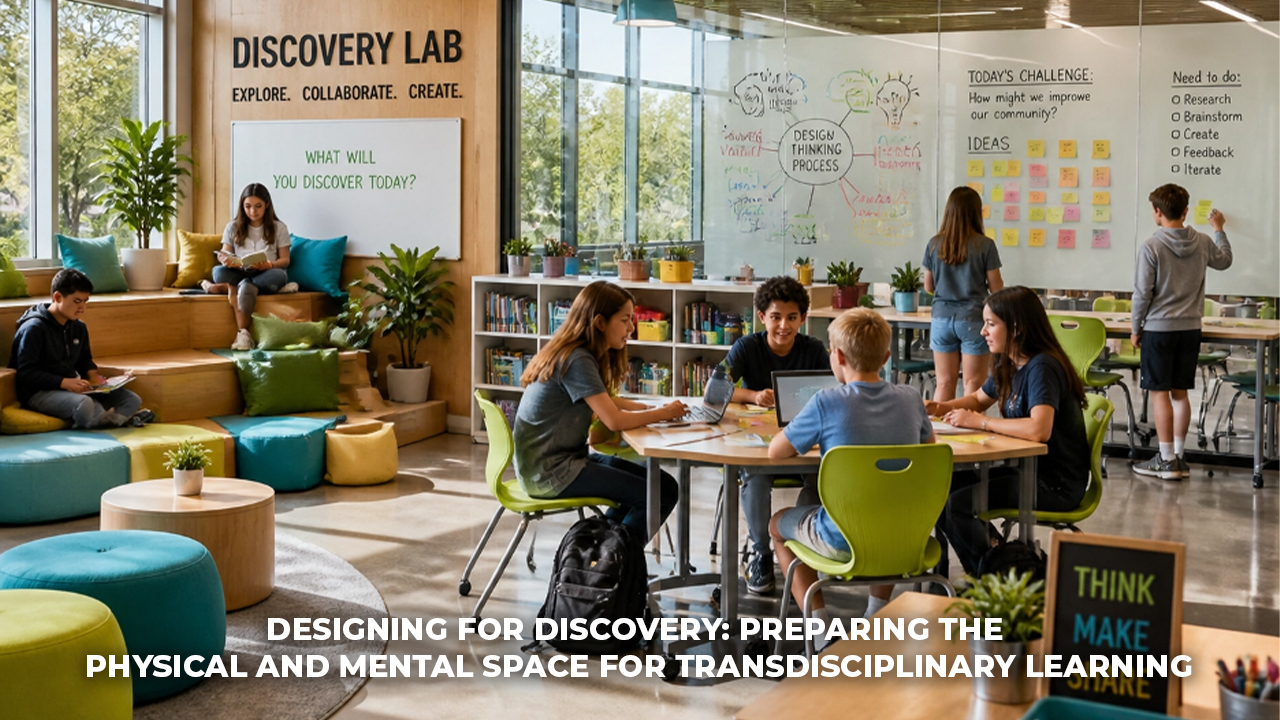
Think of your classroom not as a grid of seats but as a collection of "learning nodes." Even in a small space, you can create distinct zones that signal different types of cognitive work:
- Collaboration Zones: Group tables or "pods" with writable surfaces. These are for the "messy middle" of a project, when ideas are flying.
- Making & Prototyping Zones: This doesn't need to be a full-blown workshop. A dedicated corner stocked with cardboard, tape, and low-tech tools can serve as an Advanced Fabrication station for early-stage prototypes.
- Reflection & Focus Zones: We often forget that discovery requires quiet. A "nook" with soft seating or a quiet corner gives students space to decompress and process what they’ve learned.
- The Dialogue Zone: An open area where the entire community can gather for Socratic seminars or "cross-pollination" sessions to share their progress.
Movement as a Learning Tool
At PAST, we often talk about "hacking school." In our guide, Hacking School: Five Strategies to Link Learning to Life, we emphasize that learning is a physical act. If your furniture can’t move, your learning will stay static. If you have the budget, look for chairs on casters and nesting tables. If you don’t, consider how you can use the hallways or even the "negative space" in your room. Could the back of a bookshelf become a vertical whiteboard? Could the floor be used for large-scale mapping?
Bridging Mind and Matter: The Connected Campus
Transdisciplinary learning shouldn't be confined to four walls. We like to think about the "Connected Campus" philosophy. This is the idea that the entire school, from the cafeteria to the garden, is a learning resource.
When you design for discovery, you’re looking for ways to connect the physical space to the broader world. This might mean bringing in community partners or using digital tools to bridge the gap. For those interested in how technology reshapes our spaces, exploring the AI Symposium or our work with Digital Nomads can offer a visionary look at where learning actually happens.
Universal Design for Learning (UDL)
Physical space is a tool for equity. By providing varied seating, sensory supports, and clear visual cues, you design for the reality that all learners are different. This isn't an "extra" task; it's the foundation of a successful transdisciplinary classroom. When a student knows they have the agency to choose where they work, whether that's a standing desk or a floor cushion, they are more likely to engage deeply with the material.
Practical Summer Steps: The "Discovery Audit"
As you prep this month, you don't need a full renovation to make a big impact. Here’s a quick checklist to help you reimagine your space:
- The Sightline Check: Sit in a student’s chair. What do you see? If you see only the back of someone’s head or a teacher’s desk, how can you reposition the furniture to promote eye contact and collaboration?
- The Friction Test: How hard is it for a student to get a pair of scissors or a piece of paper? When materials are "gatekept" by the teacher, agency dies. Move your supplies to a student-accessible STEM Maker Space-style station.
- The "I Don't Know" Wall: Dedicate a space on your wall for "Big Questions." Not questions with answers, but the kind of inquiries that fuel a semester-long project.
- The Nature Connection: Can you bring a bit of the outdoors in? Plants, natural light, or even photos of the local ecosystem can reduce stress and boost creativity. Check out our STEM Activities at Home for ideas on how to connect environmental science to your physical space.
Empowering the Next Generation
Ultimately, designing for discovery is about more than aesthetics. It’s about building a collaborative ecosystem that prepares students for the world they will inherit. The workforce doesn't operate in silos, and our classrooms shouldn't either. By aligning your physical and mental environments, you give your students the grit, confidence, and resilience they need to tackle future challenges.
How are you planning to "hack" your space this year? What's one mental shift you're working on this summer? Connect with us and let us know: we’d love to hear your vision for a discovery-ready classroom!
Next week, we’ll discuss the "Culture of Yes" and how to establish a safe-to-fail environment that keeps the discovery phase going year-round. Stay tuned!
Author: Annalies Corbin, PAST Foundation, USA



Responses